Poland’s predator in Ukrainian service: an overview of the Rosomak APC
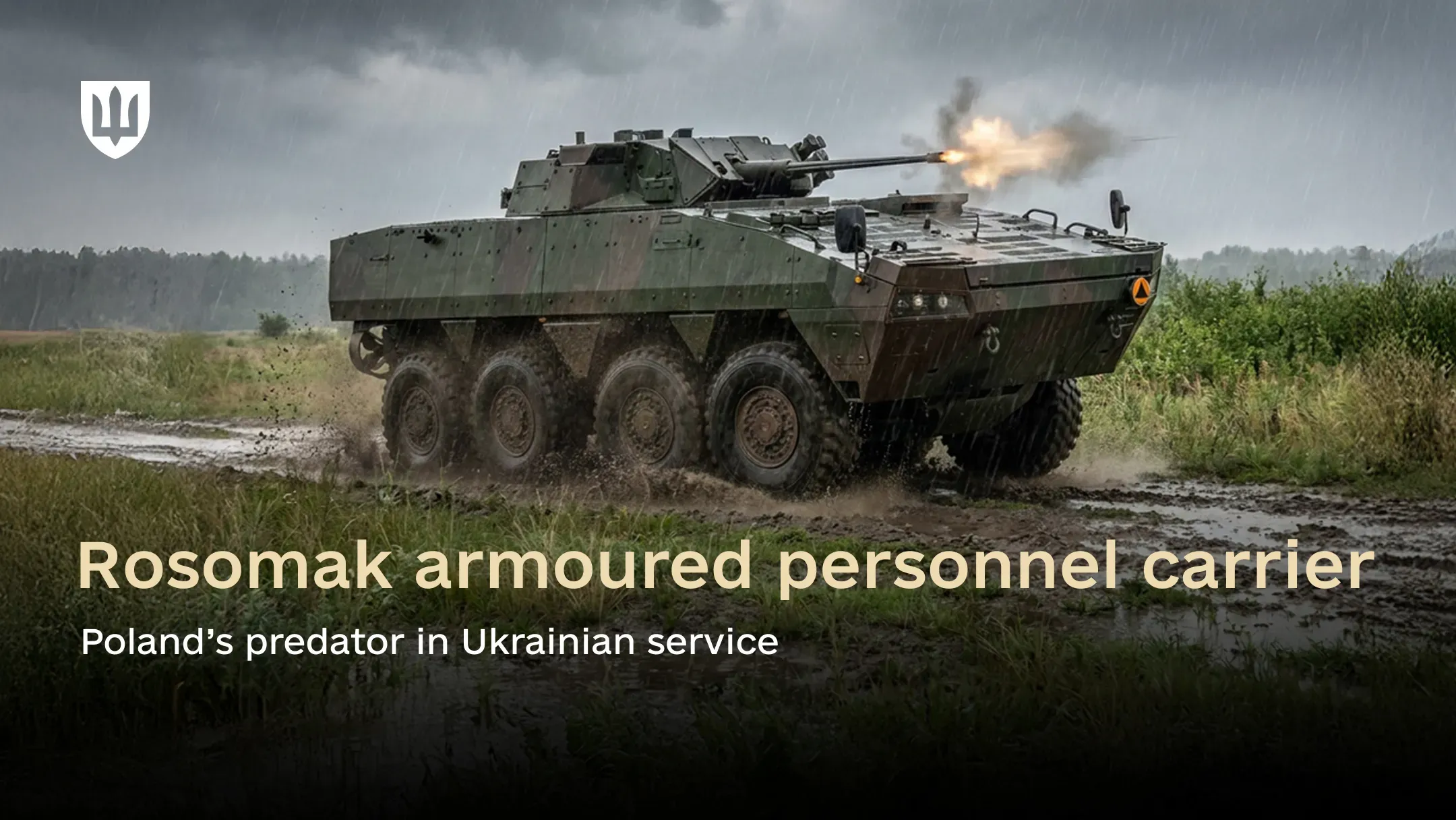
Polish-made Rosomak armoured personnel carriers have been in service with the Defence Forces of Ukraine for several years. Service members highlight the vehicle’s high manoeuvrability and the firepower of its weapons systems.
The Rosomak name suits the vehicle well. The vehicle is named after a predator from the mustelid family, known for its toughness, endurance, and strength despite its compact size.
According to Ukrainian service members, Rosomak vehicles are easy to operate, manoeuvrable, fast, survivable, and effectively armed.
The Ministry of Defence of Ukraine outlines what is known about the Rosomak APC.
Technical specifications of the Rosomak: a powerful predator
The Rosomak is a multi-purpose 8×8 wheeled armoured personnel carrier weighing between 22 and 26 tonnes, depending on its armour configuration. Its modular design allows the vehicle to be quickly adapted for a range of missions, from medical evacuation to fire support.
The Defence Forces of Ukraine currently operate both the combat variant equipped with the Hitfist-30P turret and the Rak self-propelled mortar system.
Rosomak APC layout: three sections
The front section houses the driver’s position on the right and the engine on the left. This layout improves crew protection during frontal fire.
The central section contains the fighting compartment and the positions of the commander and gunner.
The rear section accommodates a troop compartment for eight fully equipped personnel.
Troops dismount through the rear doors or ramp, allowing infantry to deploy under the protection of the armoured hull.
Rosomak engine and speed: the powerful heart driving the vehicle to 100 km/h
At the heart of the Rosomak is a powerful engine system that gives the heavy vehicle the mobility of a passenger car.
- Engine: a 480–490 hp diesel engine. The engine is noted for its reliability and high torque output.
- Speed: on paved roads, the Rosomak is capable of reaching speeds of up to 100 km/h. Its high power-to-weight ratio allows it to traverse rough terrain and steep inclines confidently.
On a single tank of fuel, the vehicle can travel up to 700 km, making it well-suited for rapid long-distance manoeuvres.
Rosomak firepower: cannon, machine gun, and a modern digital fire-control system
The most widely used Rosomak APC variant is fitted with the two-person Hitfist-30P turret.
The American 30 mm ATK Mk 44 Bushmaster II automatic cannon can engage targets using programmable airburst ammunition. It is effective against lightly armoured targets, helicopters, and enemy personnel.
Machine gun: a coaxial 7.62 mm UKM-2000C machine gun.
A modern digital fire-control system with thermal imaging sights enables the crew to conduct accurate fire during the day and at night, as well as in adverse weather conditions.
Rosomak armour and protection: the APC can withstand 14.5 mm hits
One of the Rosomak’s greatest advantages is its multi-layered armour protection.
- Basic protection. The hull is constructed from welded steel armour plates. In the base configuration, it provides frontal protection against 14.5 mm rounds and side protection against 7.62 mm rounds.
- Additional armour protection. The vehicle is often equipped with ceramic armour modules that raise protection to STANAG 4569 Level 4, providing all-round protection against 14.5 mm armour-piercing rounds and frontal protection against 30 mm projectiles.
- Mine protection. The V-shaped hull and specially suspended troop seats reduce the impact of mine and improvised explosive device blasts.
These features make the APC an effective means of protecting personnel in conditions of intense shelling and mine threats.
Amphibious capabilities: the Rosomak can reach speeds of up to 10 km/h in water
The Rosomak retains amphibious capability, though this imposes a limit on the maximum weight of additional armour protection.
Two propellers mounted in ring nozzles are installed at the rear section of the vehicle. They provide water speeds of up to 10 km/h.
During water crossings, a bow wave shield is raised at the front, while a bilge pump removes excess water from the hull.
Advantages of the Rosomak APC
Ukrainian service members give the Rosomak high marks:
- Ease of operation – the vehicle is simple to operate, and personnel can quickly become proficient with it;
- Weapon effectiveness – the Bushmaster cannon has a high rate of fire (200 rounds per minute) and allows quick switching between ammunition types;
- Manoeuvrability and speed – the vehicle effectively carries out combat tasks, including rapid movement into position, engagement of targets, and swift withdrawal;
- Crew survivability – the APC effectively performs its primary function of preserving crew lives even under constant enemy drone attacks, with damaged vehicles subsequently repaired and returned to operational service.
Overall, the Polish Rosomak APC is a versatile and resilient combat vehicle. It combines Western levels of crew comfort, powerful armament, and high mobility.
Earlier, the Ministry of Defence explained the key features and advantages of the Ukrainian BTR-4 Bucephalus APC.