Enemy logistics in Luhansk Oblast and on routes to Crimea brought under fire control: middle-strike results in May
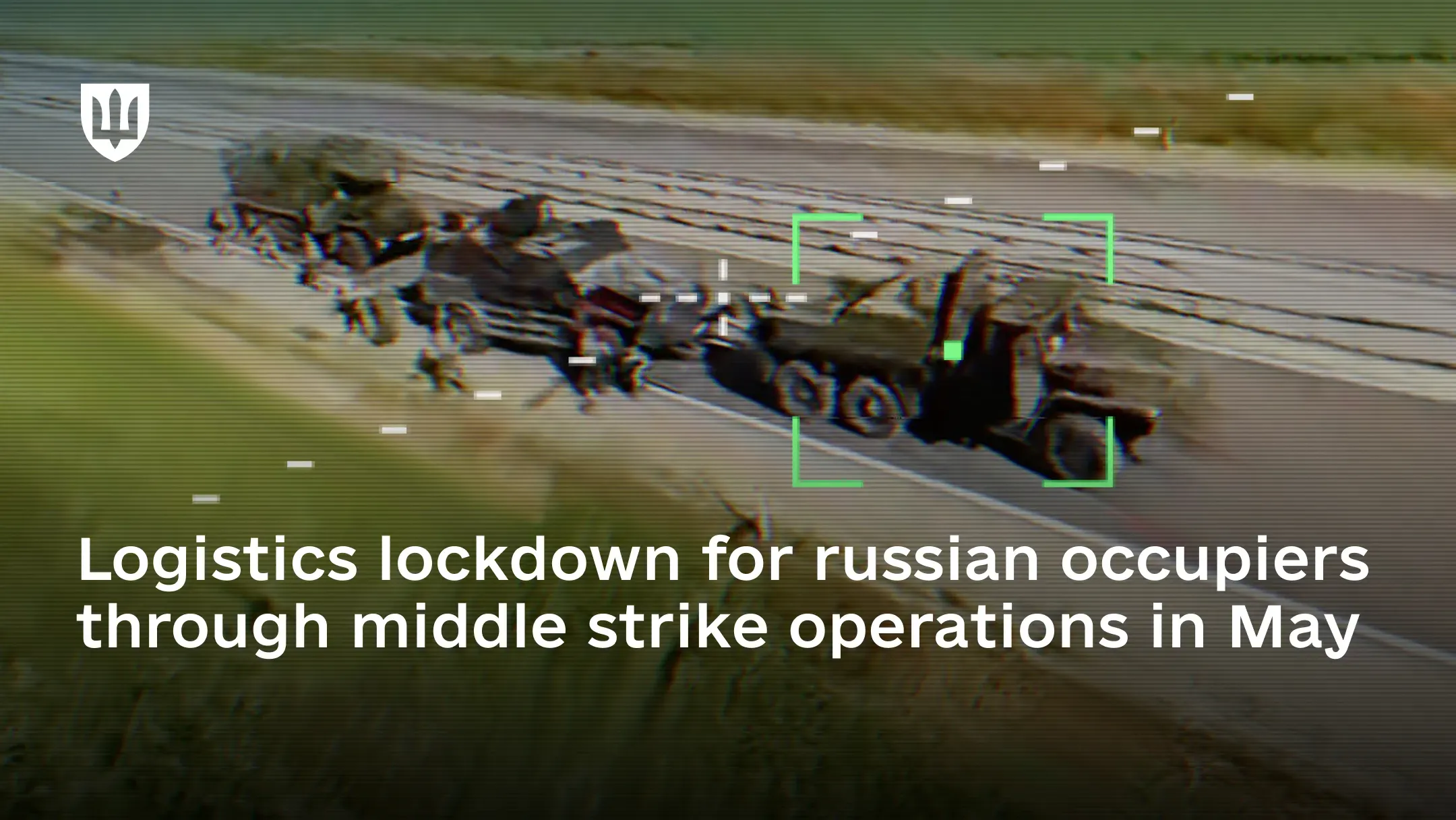
Throughout May 2026, units of the Defence Forces of Ukraine continued to use middle-strike operations to methodically destroy russia’s logistics, depots, headquarters, air defense systems, and other components of russia’s offensive operations.
Of particular significance is that key russian logistics routes in the temporarily occupied areas of Luhansk Oblast and Eastern Slobozhanshchyna, as well as the route between the temporarily occupied cities of Berdiansk, Melitopol, and Dzhankoi (referred to by the enemy as the R-280 highway), have been brought under fire control. The “R-280 highway” route connects Rostov-on-Don to temporarily occupied Crimea.
The Ministry of Defence outlines the key achievements of Ukrainian defenders and the losses sustained by russia as a result of middle-strike operations in May.
Logistics lockdown of russia creates conditions for ending the war
The systematic destruction of the enemy’s logistics in the operational rear helps Ukraine contain the enemy on the front line and move closer to ending the war from a position of strength. As the President of Ukraine has emphasized, this window of opportunity is expected to remain open for another six to nine months.
Therefore, acting on the President’s directive, the Ministry of Defence is scaling up middle-strike capabilities to the maximum extent and, in coordination with the military, creating a complete logistics lockdown for the enemy. As part of the first phase of the program, the Ministry of Defence, together with the General Staff of the Armed Forces of Ukraine, allocated an additional UAH 5 billion directly to the military for the procurement of modern middle-strike capabilities.
At the same time, support from allies could be decisive while Ukraine maintains the initiative and remains in a position to increase pressure on the enemy.
Fire control over logistics routes in Luhansk Oblast up to the russian border
Logistics routes used by russian occupation forces in Luhansk Oblast and Eastern Slobozhanshchyna have been brought under sustained fire control.
Enemy armored vehicles and depots near the Izvaryne border crossing on the Ukraine–russia border, more than 205 kilometers from the front line, were successfully struck.
Ukrainian drones have established continuous fire control over logistics in the areas of Luhansk, Starobilsk, Alchevsk, Brianka, and Kadiivka.
The logistics collapse in Luhansk Oblast is degrading the aggressor’s forward units, depriving them of offensive potential.
Routes between Berdiansk, Melitopol, and Dzhankoi are now under the Defence Forces of Ukraine’s fire control
The so-called russian “R-280 federal highway” is a key military logistics corridor extending more than 500 kilometers. It connects Rostov-on-Don with temporarily occupied Crimea through Donetsk, Zaporizhzhia, and Kherson Oblasts, including via Mariupol, Berdiansk, and Melitopol. This route serves as the primary “land corridor” and lateral supply route for delivering fuel, ammunition, and equipment to russia’s entire southern grouping of forces.
Ukrainian drones are now routinely striking cargo vehicles, fuel tankers, and military equipment along the full length of the route. Successful strikes against logistics vehicles have been recorded in the areas of Chonhar and Sokolohirne, as well as on routes leading from the temporarily occupied peninsula.
Fire strikes are being conducted not only against moving targets along the route itself, but also against supporting infrastructure, including logistics depots, vehicle parks, and repair facilities in occupied cities along the Sea of Azov coast.
Combined with strikes on railway hubs, such as Debaltseve, and bridge crossings, the disruption of road traffic deprives the russian army of the ability to rapidly move reserves between the Zaporizhzhia and Kherson sectors.
19 russian air defense and radar assets struck
The Defence Forces of Ukraine continue their systematic efforts to “blind” the enemy. During May, strikes were confirmed against 10 surface-to-air missile systems and missile-gun systems, as well as 9 radar stations and technical reconnaissance assets.
Among the systems put out of action were three Pantsir-S1 surface-to-air gun-missile systems in Novyi Svit, Henicheska Hirka, and at Saky Airfield; four Tor and Tor-M2 air defense systems in Mykhailivka, Staryi Oskol, Zakhidne, and Berdianske; a Buk-M3 system in Olkhovatka; an Osa surface-to-air missile system in Donetsk; and a command-and-control vehicle from a Buk-M2 air defense system in Kadiivka.
Ukrainian defenders also struck the MYS-M1 coastal radar station in Maiak, the Podlyot radar system in Yevpatoria, the P-18 Terek radar station in Sofiivka, the Kasta-2E radar station in Mysove, the Yastreb counter-battery radar in Novoselivka, the 1L125 Niobiy-SV radar station in Yarsk, the Nebo-SV radar station in Kamianka, the ST-68 air surveillance radar in Feodosia, and the MR-232 Bussol-S radar with an electro-optical module located at an FSB coastal technical reconnaissance post in Mariupol.
In addition, during May, Ukrainian forces destroyed 8 headquarters and 25 UAV command posts, while also striking more than 50 depots and repair facilities.
As previously reported, in April, Ukraine struck 25 russian air defense and radar systems, as well as more than 55 russian military logistics facilities and depots through middle strike operations.
Overall, in April, the number of successful strikes against enemy depots, headquarters, air defense systems, and logistics infrastructure at ranges of 20–150 km doubled compared to March and increased fourfold compared to February.