More than 30 air defense, radar, and EW assets and more than 40 command posts hit: results of middle-strike operations in September
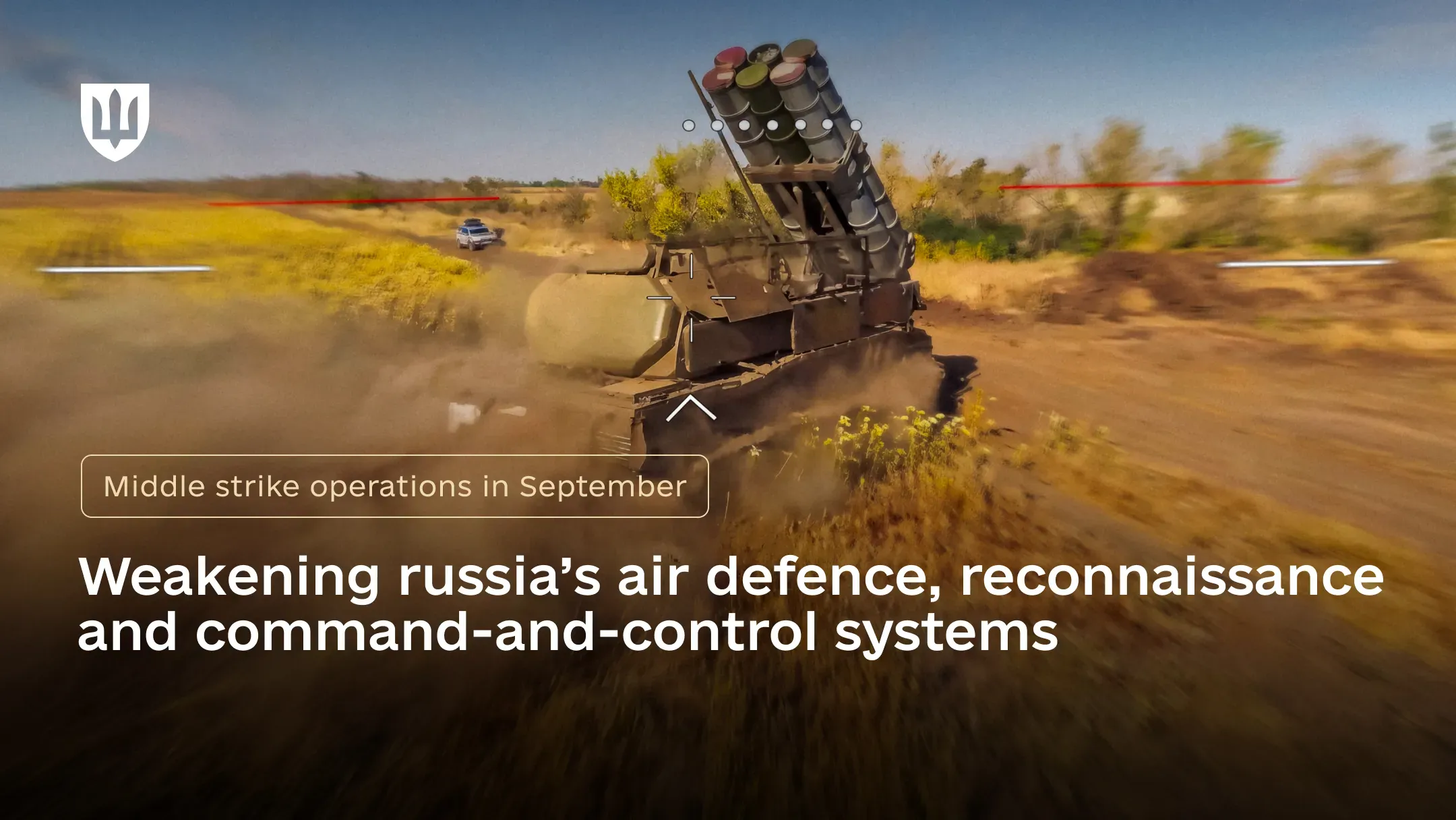
In September 2026, the Defence Forces of Ukraine continued their systematic middle-strike campaign against the enemy’s operational rear areas and military capabilities.
According to figures made public by the General Staff, the following were hit during the month:
- more than 30 air defense, radar, and electronic warfare (EW) assets;
- more than 40 command posts, including those of UAV units;
- more than 50 depots, bases, and other logistics and support facilities;
- more than 20 infrastructure facilities related to the storage, preparation, production, and use of UAVs.
Systematic strikes at operational depth reduce the combat capabilities of russian forces, disrupt command and control of their units, and complicate their sustainment.
The Ministry of Defence of Ukraine outlines the main results of the use of middle-strike assets in September.
Weakening russian air defense: S-400, Buk-M3, and Krasukha-4 systems hit
Striking russian air defense, radar, and electronic warfare systems remains a priority.
In September, the Defence Forces of Ukraine struck, among other targets, two S-400 surface-to-air missile system launchers in russia’s Bryansk region, a 92N6 multifunction radar belonging to an S-400 system in Sochi, a Buk-M3 surface-to-air missile system in the Zaporizhzhia region, as well as Pantsir-S1 and Pantsir-S2 surface-to-air gun-missile systems.
Radar assets hit included Nebo-U, Nebo-SV, Podlet, Kasta, and P-18 radar stations, as well as other enemy radars.
Electronic warfare and technical reconnaissance systems were also struck, including a mobile Krasukha-4 EW station and Grenader automated technical reconnaissance posts.
Systematically striking these assets reduces the enemy’s ability to control the airspace and counter Ukrainian strike assets.

Reducing russian UAV capabilities
Throughout September, the Defence Forces of Ukraine systematically struck russian unmanned systems infrastructure.
Sites used to store, prepare, and launch Geran- and Gerbera-type strike UAVs in the Donetsk area were struck repeatedly. Similar facilities in other temporarily occupied territories and in russia were also struck.
Dozens of UAV command posts, ground relay stations, and other elements of the UAV command-and-control system were hit.
In particular, a training center for UAV operators of the Akhmat unit was hit in Petropavlivka, Luhansk region; a UAV production site was struck in Siverskodonetsk; and a ground control station for Orion reconnaissance-strike UAVs was hit near Saky airfield.
Targeting infrastructure supporting strike UAVs remains a distinct priority. These efforts are aimed at reducing the russian military’s ability to use unmanned systems to strike Ukraine.
Striking russian depots and continuing the logistics lockdown
Throughout the month, the Defence Forces of Ukraine struck depots storing ammunition, materiel, fuel, and lubricants, as well as repair bases and storage sites for enemy weapons and military equipment.
Overall, more than 50 such facilities were struck in September across the temporarily occupied territories of Ukraine and russia’s border regions.
Near Vladyslavivka in temporarily occupied Crimea, a railway bridge over the North Crimean Canal used by russian forces for military logistics was struck.
Systematic strikes on depots, repair infrastructure, and logistics facilities complicate the sustainment of russian frontline units.
Striking aviation, naval assets, and military facilities: Su-24 at Saky and boats in Sevastopol
Other important enemy military targets were also struck in September.
A Su-24 aircraft was hit at Saky Airfield in temporarily occupied Crimea. The destruction of an enemy MiG-29 aircraft and a Ka-27 helicopter was also confirmed during the month.
In Sevastopol, a BK-16 landing craft and a Project 12150 Mangust-class fast patrol boat were hit.
In Snizhne, Donetsk region, a machine-building plant used by the russian defense industry to manufacture military products was hit.
The systematic use of middle-strike assets enables the Defence Forces of Ukraine to steadily reduce the enemy’s combat capabilities and disrupt its command-and-control, air defense, and logistics systems.
As previously reported, middle-strike operations by the Defence Forces of Ukraine in August hit 6 bridges, more than 20 depots, and more than 30 enemy command posts.