Middle-strike operations: how Ukrainian drones are degrading russia’s military potential
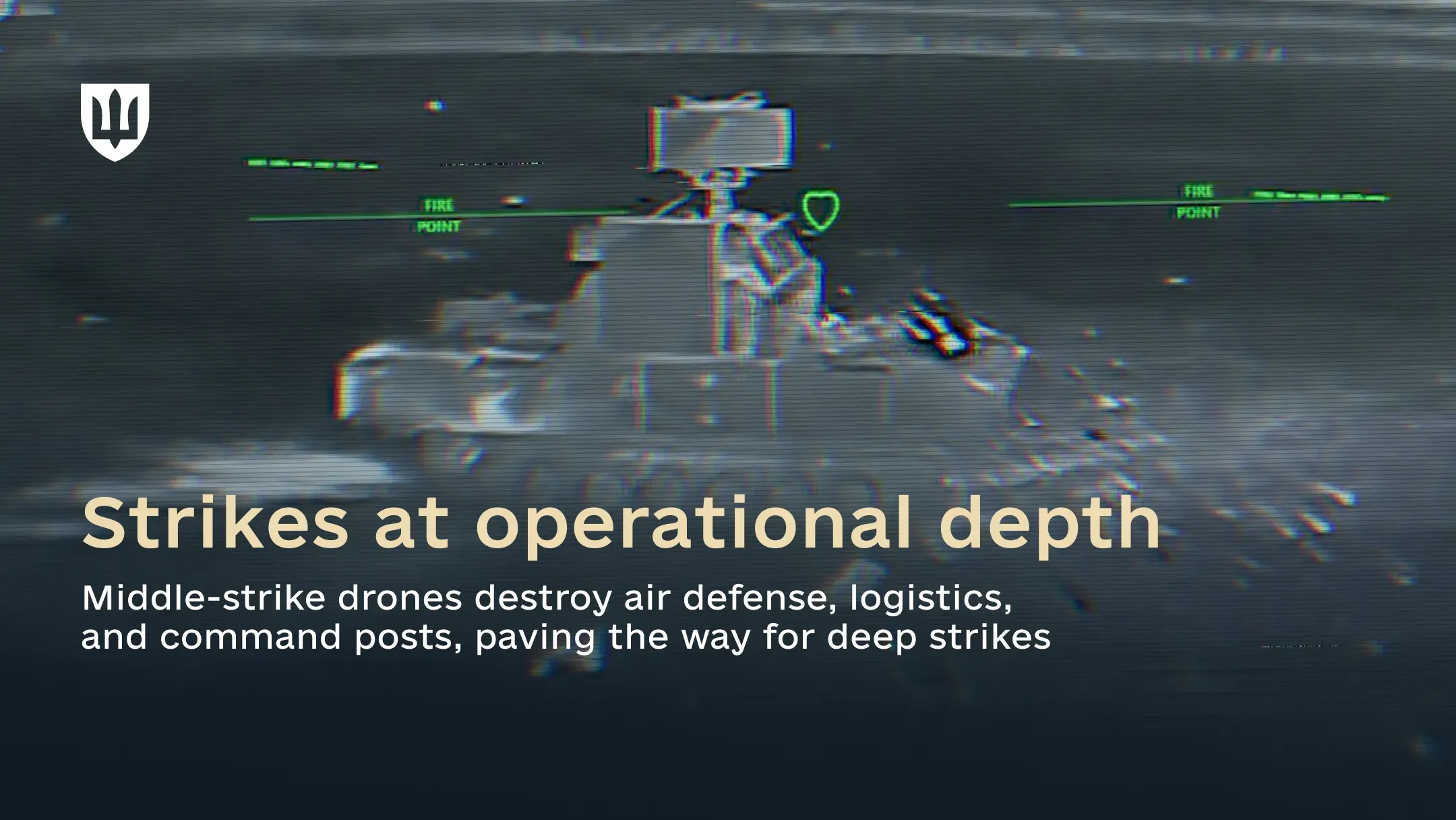
Ukraine is systematically scaling up the use of mid-range strikes, i.e. strike UAVs operating at operational depth over distances ranging from tens to hundreds of kilometers.
This segment fills the critical gap between frontline strikes by FPV drones and strategic deep-strike attacks deep inside russia.
Middle-strike operations enable the destruction of targets that directly affect the enemy’s ability to conduct offensive and defensive operations: air defense systems, radars, warehouses, command posts, logistics, and oil and energy infrastructure.
Operational depth of strikes
FPV drones reshaped the tactical level of warfare. Deep-strike drones and missiles hit strategic targets deep inside russia.
Middle-strike operations fill the gap between them, enabling systematic strikes at ranges of around 30-200 km.
It is at this depth that the enemy maintains a significant portion of the critical infrastructure that supports the front line: ammunition depots, command posts, supply routes, air defense systems, radars, and drone control centers.
Strikes against such targets degrade the russian army’s ability to rapidly move resources and maintain offensive operations.
Enemy air defense is one of the key strike priorities
One of the main priorities for mid-range strikes is destroying russian air defense systems and radars.
In 2026, Ukraine began systematically degrading russia’s ability to defend against aerial threats. For example, in April, the Defenсe Forces of Ukraine (including the Unmanned Systems Forces, the Security Service of Ukraine, and others) destroyed nearly twice as many air defense systems and radars as in October last year. According to the General Staff of the Armed Forces of Ukraine, the neutralization of 81 russian air defense systems has been confirmed since March 1, 2026. This gradually depletes russian reserves and creates more opportunities for strikes deep in the enemy’s rear.
Middle-strike drones, including the FP-2, Hornet, and Bulava, play a critical role in these operations. In the final kilometers of flight, such systems can operate autonomously, scanning the terrain and independently identifying targets. Their operational range extends up to 200 km deep into the enemy rear.
This changes the situation fundamentally. When russian air defense loses radars, launchers, and cover assets, it detects aerial threats less effectively and reacts more slowly. This opens the way for further strikes, including both middle-strike and deep-strike operations.
Crimea: systematically degrading russian air defense
Another key area of operations is the temporarily occupied Crimea. The Defence Forces are systematically targeting russian air defense systems on the peninsula. Since the beginning of the year, twelve Pantsir air defense missile and gun systems of various variants have been neutralized in Crimea.
This is significant because Pantsir systems are part of the air defense cover protecting russian military facilities, airfields, depots, and command posts. Their destruction degrades russia’s defensive architecture and creates conditions for the further isolation of the peninsula.
In addition, strikes are targeting hangars, radars, S-400 systems, and UAV control systems.
Such operations produce a cumulative effect: russia loses not only individual assets, but also entire elements of its command, surveillance, and defensive architecture.
From the front line to the moscow region
Middle-strike operations are not limited to Crimea. Similar operations are ongoing in other temporarily occupied regions and along russia’s border areas.
The systematic weakening of the enemy’s air defense and logistics creates conditions for deeper strikes. One of the most illustrative outcomes has been the successful strikes against targets near moscow.
In particular, the targets struck by the Defence Forces of Ukraine included the Moscow Oil Refinery, the Solnechnogorskaya fuel loading station, the Volodarskaya petroleum-product pumping station, and the Angstrem microelectronics plant in Zelenograd, near moscow.
This operation is particularly significant given that the city of moscow and the moscow oblast are among the most heavily defended regions in russia. The high concentration of air defenses makes targets in this area especially difficult to strike.
However, the results demonstrate that there are no longer any completely safe locations for russian military infrastructure anywhere in russia. Ukraine is systematically degrading air defense systems, logistics, and support infrastructure, while steadily increasing strike depth.
Why middle-strike operations are emerging as a game-changer
Middle-strike operations are gradually emerging as one of the key tools in the war. They provide Ukraine with several advantages at once.
First, flexibility. These systems can be rapidly adapted to specific targets, electronic warfare (EW) conditions, and evolving battlefield requirements.
Second, scalability. These systems are less expensive than traditional missile systems and can be manufactured in greater numbers.
Third, a systematic approach. Middle-strike operations enable daily strikes against targets that sustain the russian military.
Fourth, enabling deep-strike operations. When Ukraine destroys russian air defense systems at operational depth, it creates more opportunities for strikes against strategic targets.
Flexibility and safety for operators
Another advantage of middle-strike drones is flexibility, ease of use, and safety for operators.
Such systems are not tied to a specific launch location. They can be launched from different locations depending on mission requirements, battlefield conditions, and threat levels.
Middle-strike systems can be deployed quickly. A military unit can quickly prepare the system for operation, complete the mission, and relocate. This also reduces risks for operators.
Flexible training enables operators to quickly learn how to use middle-strike systems and share effective tactics between units.
Contracting and production volumes are increasing
Ukraine is scaling up its middle-strike capabilities. This year, contracts have already been signed for five times more middle-strike systems than last year. Procurement and production will continue to expand.
Partners also recognize the effectiveness of this capability segment.
Germany will provide $600 million to support the development of Ukraine’s deep-strike and middle-strike capabilities. As part of the Build with Ukraine initiative, joint production of middle-strike drones incorporating AI technologies is also being launched. During the first phase, several thousand drones are planned to be produced for the Defence Forces.
Another important area is cooperation with Norway. Ukraine and Norway are launching their first joint production project for Ukrainian drones. Several thousand middle-strike drones are planned for manufacture in Norway.
This is an example of a win-win partnership that is part of Ukraine’s defense strategy: Ukraine receives expanded production capacity and more capabilities for the front line, while partners gain access to technologies and expertise proven in real warfare.
Ukraine calls on partners to continue investing in priority capabilities, including air defense, Ukrainian drones and missiles, middle-strike and deep-strike capabilities, and long-range munitions. These are the capabilities that have already proven their effectiveness and will help Ukraine end the war from a position of strength.