Ukraine to receive a “naval sapper” from the Netherlands: overview of the Alkmaar-class minehunter
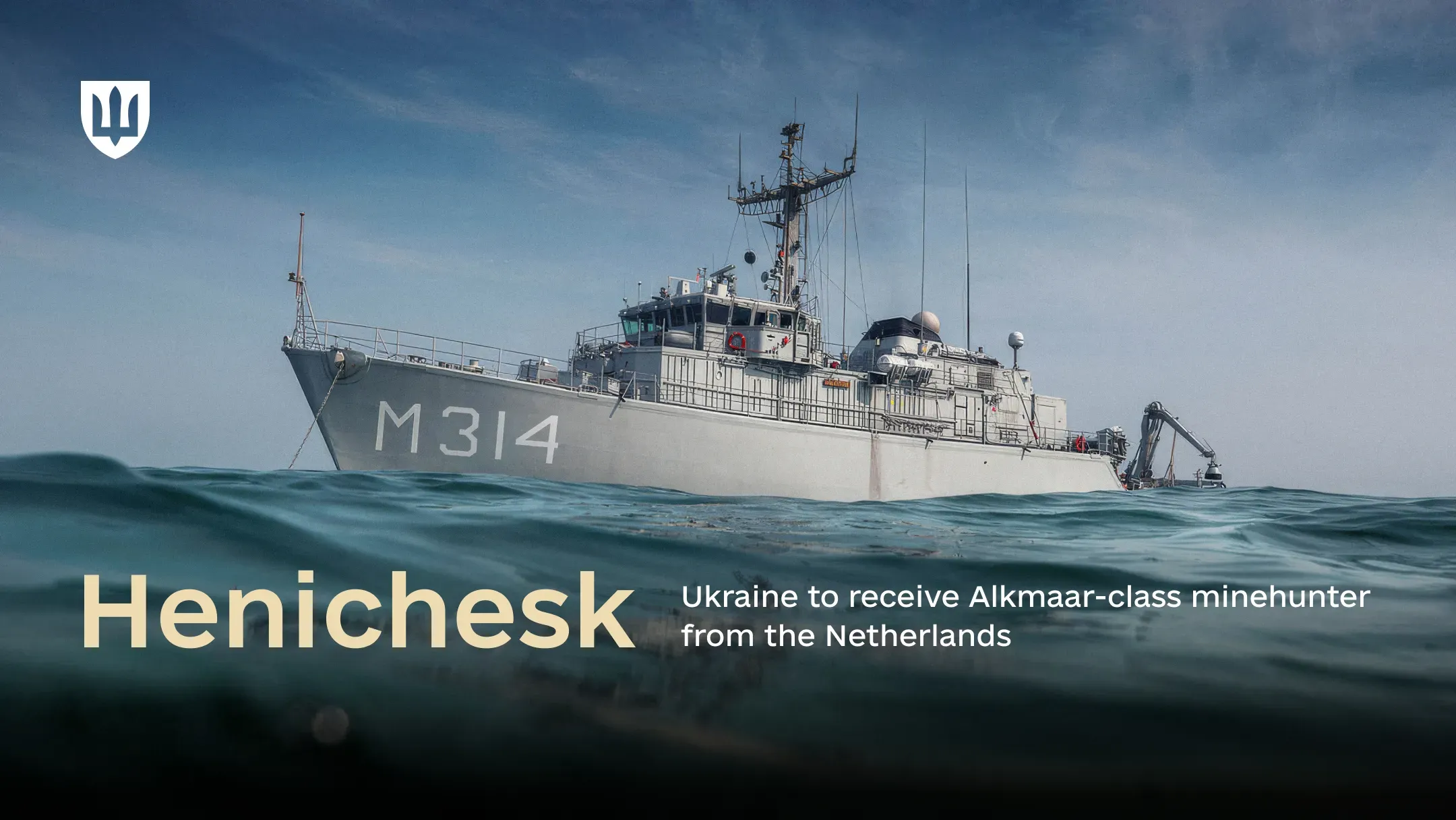
Ukraine will receive the Alkmaar-class minehunter HNLMS Makkum from the Netherlands. Upon joining the Ukrainian Navy, the vessel will be named ‘Henichesk’ in honour of the ship lost during a combat mission near the Kinburn Spit in June 2022.
In Vlissingen, the Netherlands, the President of Ukraine met with Ukrainian service personnel already undergoing training on board the vessel. A significant number of the sailors have combat experience, including at sea.
The crew is mastering the use of various types of underwater drones to detect, identify and neutralise mines. The Head of State decorated seven Ukrainian defenders with the medals ‘For Military Service to Ukraine’ and ‘Defender of the Motherland’.
The Ministry of Defence of Ukraine outlines key facts about Alkmaar-class minehunters.
Operational role of Alkmaar-class minehunters
The primary role of Alkmaar-class minehunters is to provide maritime safety in the open sea, coastal waters and harbour approaches by countering naval mines, as well as to protect naval formations in areas of mine threat.
They may also be employed to support land operations from the sea, including the clearance of coastal zones ahead of amphibious landings.
They may also be used to locate sunken vessels and lost containers that pose a threat to navigation.
Alkmaar-class minehunters: technical specifications
Key technical specifications of the Alkmaar-class minehunters include:
- Crew: 28–38 personnel
- Displacement: 543 tonnes
- Length: 51.5 m
- Beam: 8.9 m
- Draught: 3.8 m
- Maximum speed: 13 knots (~24 km/h)
The vessel is equipped with a diesel propulsion system for long-range transit, complemented by auxiliary thrusters enabling high-precision manoeuvring during mine countermeasure operations.
Mine detection capabilities: sonar and unmanned underwater vehicles (UUVs)
The vessels are equipped with a hull-mounted sonar system designed for the detection of underwater objects, including mines.
In challenging hydrographic conditions, remotely operated underwater vehicles, along with towed and variable-depth sonar systems, are employed to further classify detected objects.
The command and information system integrates sensor data, enables the control of mine countermeasure assets, and coordinates crew actions.
Mine neutralisation capabilities of Alkmaar-class minehunters
The vessels are equipped with light weapons, including heavy machine guns for self-defence.
The primary mine neutralisation systems are remotely operated vehicles (ROVs) for underwater operations, including SeaFox systems. They are used to identify underwater objects and, upon confirmation of a threat, to neutralise them by delivering an explosive charge directly to the target.
Divers may also be employed to conduct specialised explosive ordnance disposal operations.
Why Alkmaar-class minehunters have fibreglass hulls
The hulls are made of non-magnetic materials (polyester-based fibreglass), which minimises the risk of triggering mines with magnetic fuses. The superstructure is constructed from light alloys.
The use of such materials is standard for mine countermeasure vessels, as steel hulls generate a magnetic field that can activate naval mines.
Significance of the minehunter ‘Henichesk’ for Ukraine
Ukraine will receive ‘Henichesk’ as the fifth vessel of this type. Four previous vessels were provided by the United Kingdom, Belgium and the Netherlands: ‘Cherkasy’ and ‘Chernihiv’ (Sandown-class), and ‘Mariupol’ and ‘Melitopol’ (Alkmaar-class).
‘Henichesk’ is expected to take part in the Sea Breeze exercise in 2027.
At this stage, all five vessels will be based in the United Kingdom. Following the end of the war, they will participate in maritime demining operations and significantly strengthen the capabilities of the Ukrainian Navy.