The Urals no longer a rear area: in April, Ukrainian deep strike operations hit 14 refineries and terminals, 2 plants, as well as russian vessels and aircraft
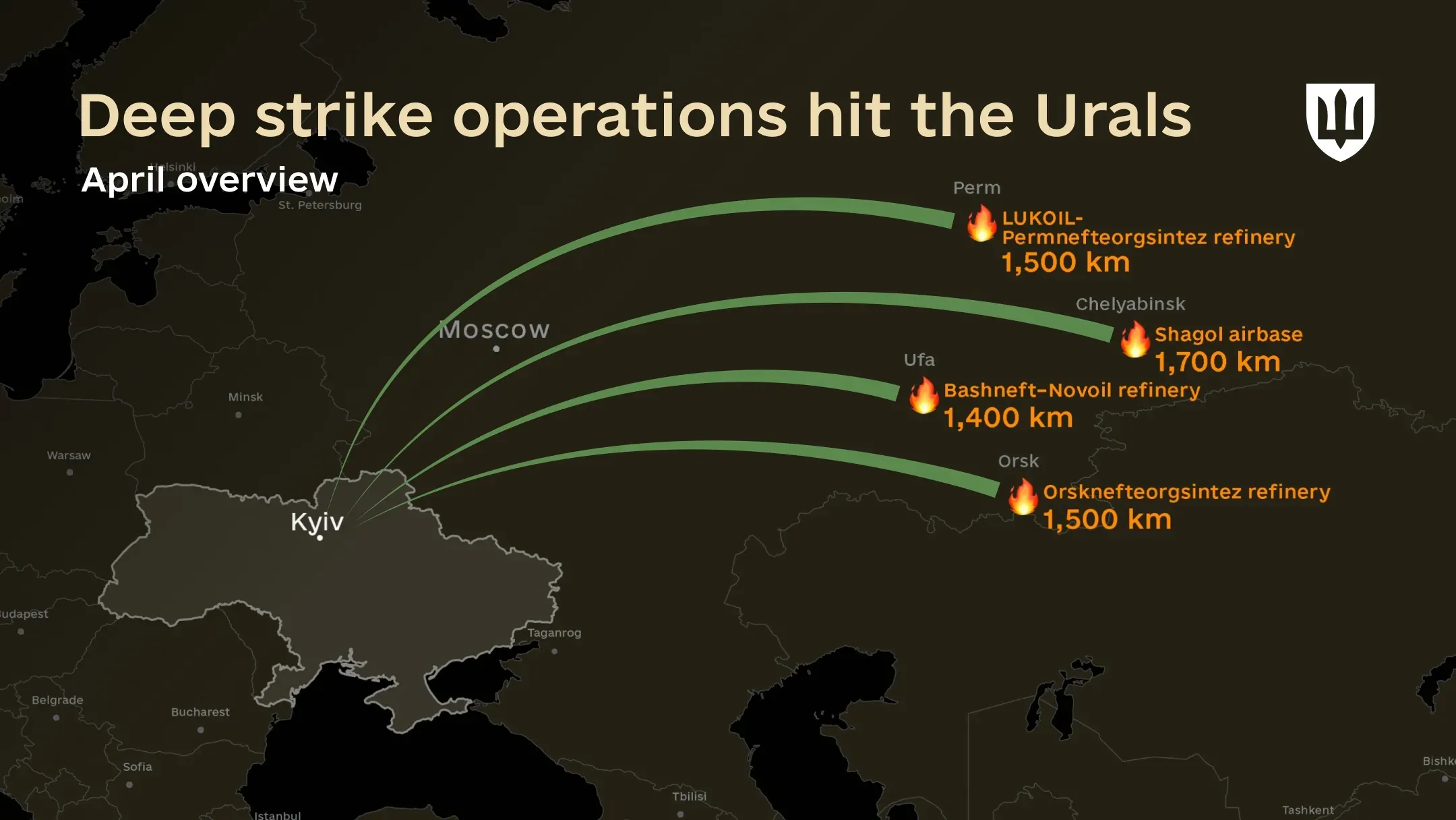
April 2026 marked another month of a systematic deep strike campaign by the Defence Forces of Ukraine against russia’s military-economic infrastructure. Deep strike capabilities hit targets ranging from temporarily occupied Crimea to Perm, Ufa, Orsk, and Chelyabinsk — that is, the Urals, which has historically been considered russia’s deep rear.
As noted by the President of Ukraine, since the beginning of the year, the aggressor state has lost at least $7 billion directly as a result of Ukrainian “targeted sanctions” against russia’s oil industry and refining sector.
“Following the results of April this year, our long-range sanctions have reached a new level across three components: reducing russia’s oil revenues, the range, and the intensity. Importantly, it is not only about hitting the target, as defined by the combat mission, but also about extending downtime of the targeted facilities or at least significantly reducing their operations,” the President of Ukraine emphasized.
The Ministry of Defence outlines which refineries, port terminals, Black Sea Fleet warships, drone-manufacturing facilities, and aircraft were targeted by Ukrainian defenders last month, as well as other russian losses.
Oil refining and fuel logistics facilities in russia targeted in April 2026
During the April campaign, the Defence Forces of Ukraine struck at least 14 such facilities, ranging from refineries in the Volga region and the Urals to port terminals in the Baltic Sea and the Black Sea.
Fire at the Bashneft–Novoil refinery, Ufa (Bashkortostan), ~1,400 km
A strike on the facility was confirmed, resulting in a fire. The strike range was approximately 1,400 kilometers from the border.
Bashneft–Novoil is among the largest producers of high-quality lubricants in russia, including marine, hydraulic, and motor oils. Crude distillation capacity is 7 million tons of crude oil per year. The facility supplies the needs of russia’s army and navy.
Fire at the LUKOIL-Nizhegorodnefteorgsintez refinery, Kstovo (Nizhny Novgorod Oblast), ~800 km
A large-scale fire was reported following a strike on the LUKOIL-Nizhegorodnefteorgsintez refinery. Elements of the AVT-6 and AVT-1 crude distillation units were damaged, along with unit 19/6, used in petroleum bitumen production. The AVT-2 crude distillation unit and the LCh-24-7 diesel hydrotreating unit were put out of operation.
With a capacity of 17 million tons per year, the refinery supplies nearly 30% of russia’s gasoline consumption and provides aviation and diesel fuel to the army and the moscow region.
Three strikes on the Tuapse oil refinery, Tuapse (Krasnodar Krai), ~1,500 km
The Tuapse oil refinery was struck on April 16, 20, and 28 — the month's most frequently targeted facility.
During the first strike, the AVT-12 crude distillation unit and RVS-10000 storage tanks were damaged, resulting in a fire. Following the second strike, 24 storage tanks were confirmed destroyed and 4 damaged. Following the third strike, a fire broke out again.
The refinery has a capacity of 12 million tons per year, accounting for 4.4% of russia’s total refining capacity. The refinery produces a wide range of Euro 5-standard petroleum products, including fuel supplied to the army.
Strike on the Novokuibyshevsk refinery, Novokuibyshevsk (Samara Oblast), ~1,000 km
The Defence Forces of Ukraine struck the Novokuibyshevsk refinery at a range of approximately 1,000 km. At this strategic facility, with a capacity of 8.8 million tons per year, explosions were reported, followed by a fire.
The refinery produces more than 20 types of petroleum products and covers a significant share of the army’s requirements. Details of the strike are being clarified.
Massed attack on the Syzran refinery, Syzran (Samara Oblast), ~900 km
The Syzran oil refinery was struck as part of a coordinated large-scale attack. A fire was reported at the facility.
This refinery is directly involved in supporting russia’s armed forces.
Damage to a distillation unit at the Yaroslavl refinery, Yaroslavl (Yaroslavl Oblast), ~750 km
A fire was reported at the facility following the strike. A vacuum distillation unit was confirmed damaged.
The refinery is one of the key facilities in russia’s oil sector, with a capacity of 15 million tons per year. It produces gasoline, diesel, and jet fuel, all essential to military logistics.
Strike on the Orsknefteorgsintez refinery, Orsk (Orenburg Oblast), ~1,500 km
A fire broke out at the Orsknefteorgsintez refinery following the strike.
The refinery has a capacity of 6.6 million tons per year and produces more than 30 types of petroleum products, including gasoline, diesel fuel, and jet fuel. It is directly involved in supplying the occupying army.
Strike by the Security Service of Ukraine (SBU) on the LUKOIL-Permnefteorgsintez refinery, Perm (Perm Krai), ~1,500 km
The strike on the LUKOIL-Permnefteorgsintez refinery was conducted using drones operated by the SBU’s Alpha Special Operations Center.
The AVT-4 crude distillation unit was damaged — a key component of crude oil processing. The vacuum and atmospheric distillation columns caught fire, effectively putting the unit out of operation. The Perm line production dispatch station, which supplies crude oil to the same refinery, was also struck again.
The refinery, with a capacity of 13 million tons per year, is one of the largest in russia and supplies fuel to both the civilian sector and the army.
Port terminals and transport infrastructure targeted
Key russian oil hubs came under attack — facilities that generate export revenues for the aggressor state’s budget and directly meet the needs of the occupying forces.
Strikes were conducted against the following port terminals and transport infrastructure:
- Primorsk port, Leningrad Oblast, ~850 km — a fire was confirmed, as well as damage to three RVSP-20000 tanks with a total volume of 60,000 m³.
- Ust-Luga Oil terminal, Leningrad Oblast, ~900 km — damage to three Transneft-Baltika storage tanks was confirmed.
- RPK Vysotsk LUKOIL-2 oil loading terminal, Vysotsk (Leningrad Oblast), ~950 km — a fire was confirmed.
- Tikhoretsk oil pumping station, Krasnodar Krai, ~300 km — a fire was confirmed.
- Sheskharis oil terminal, Novorossiysk, ~420 km — a large-scale fire at a key Black Sea oil transshipment hub.
Furthermore, oil depots in Feodosia and Hvardiiske, along with oil pumping stations in Crimea and Krasnodar Krai, were targeted as components of the tactical fuel supply system supporting russian forces.
First-ever strikes hit offshore oil platforms in the Caspian Sea
On April 10, the Defence Forces of Ukraine conducted their first strike against offshore oil infrastructure.
The ice-resistant fixed platforms LSP-2 at the Grayfer Field and LSP-1 at the Yuri Korchagin field were damaged. The facilities are located approximately 1,000 kilometers from the front line.
Strike on the tanker MARQUISE in the Black Sea
On April 29, a Ukrainian Navy unit struck the sanctioned vessel MARQUISE in the Black Sea, 210 kilometers from Tuapse. Two kamikaze unmanned surface vehicles (USVs) struck the stern, near the propeller and rudder assembly and the engine room.
The tanker, with a cargo capacity of more than 37,000 tons and registered under the flag of Cameroon, is subject to sanctions imposed by Ukraine, the EU, the United Kingdom, Switzerland, New Zealand, and Canada, and was used for the illegal transportation of petroleum products as part of the shadow fleet.
Strikes on russia’s military-industrial complex
In April, the Defence Forces of Ukraine struck two industrial facilities on the territory of the aggressor state.
Strike on the Strela plant, Suzemka (Bryansk Oblast)
The facility was struck on April 1. The plant produces components for cruise missiles and has executed over 120 state contracts for russia’s military-industrial complex.
It is subject to Ukrainian sanctions.
Strike on the Atlant Aero plant, Taganrog (Rostov Oblast)
On April 19, a unit of the Ukrainian Navy executed a precision strike using Neptune missiles against a production facility of Atlant Aero.
The plant carries out the full cycle of design, manufacturing, and testing of Molniya strike-reconnaissance UAVs. Also, it produces components for the Orion UAV — a multi-purpose drone weighing around one ton, capable of carrying up to 250 kg of payload, including KAB-20 guided aerial bombs and Kh-50 missiles.
Black Sea Fleet and maritime security forces under attack
April was marked by the consistent neutralization of russian Black Sea Fleet vessels in Sevastopol and the Kerch Strait.
In April, two large landing ships — Yamal and Nikolay Filchenkov — were put out of action in Sevastopol
On April 19, a unit of the Main Intelligence Directorate of the Ministry of Defence — Prymary — disabled two large landing ships in Sevastopol Bay.
The large landing ships Yamal (Project 775, built in 1988, cargo capacity 500 tons, estimated value over $80 million) and Nikolay Filchenkov (Project 1171, built in 1975, cargo capacity 1,000 tons, value over $70 million) are critical assets enabling amphibious landings and sustainment of russian forces in Crimea. Both vessels were put out of action. Total losses exceed $150 million.
Follow-on strikes against the same vessels were carried out on April 20 and 26 by the Security Service of Ukraine (SBU).
Strike on a Project 11356R Burevestnik-class frigate
On April 5, two strike UAVs hit a Project 11356R Burevestnik-class frigate — a Kalibr cruise missile carrier. The extent of the damage is being assessed.
Coordinated attack: signals intelligence (SIGINT) ship Ivan Khurs, Lukomka training center, and SIGINT headquarters
On April 26, as part of Operation Alpha, the Security Service of Ukraine simultaneously struck an intelligence collection ship, a Black Sea Fleet training center, and a signals intelligence (SIGINT) headquarters of the air defense forces.
A MiG-31 at Belbek airfield (a potential carrier of the hypersonic Kinzhal missile) was also struck, along with the airfield’s maintenance and engineering facilities.
Damage to a Project 22460 patrol ship of the FSB (Federal Security Service of the russian federation) Border Service
On April 22, damage to the bridge of an FSB Border Service vessel in Sevastopol was confirmed.
Destruction of Sobol- and Grachonok-class patrol boats, Kerch Strait
On April 30, a unit of the Ukrainian Navy destroyed an FSB Sobol-class patrol boat and a Grachonok-class anti-saboteur boat in the Kerch Strait area. The enemy sustained both killed and wounded personnel.
Both boats were guarding the Kerch Bridge and performing anti-sabotage tasks.
Strikes hit several Su-57 and Su-34 aircraft at Shagol airfield (Chelyabinsk Oblast)
On April 25, at Shagol airfield in Chelyabinsk Oblast, russia, the Unmanned Systems Forces of the Armed Forces of Ukraine struck two Su-57 fighters, one Su-34 fighter-bomber, and one additional aircraft of unknown type.
This was one of the longest-range Ukrainian deep strike operations — the targets were located approximately 1,700 km from the state border of Ukraine. Moreover, the Urals have long been regarded as a deep and secure rear area of russia. Ukraine has debunked this myth.
Since the start of the full-scale invasion, the Defence Forces of Ukraine have expanded the range of deep strike operations into russia’s deep rear by more than 2.5 times.