Ukraine can now reach targets in russia up to 1,750 km away, expanding deep strike range by 2.5 times
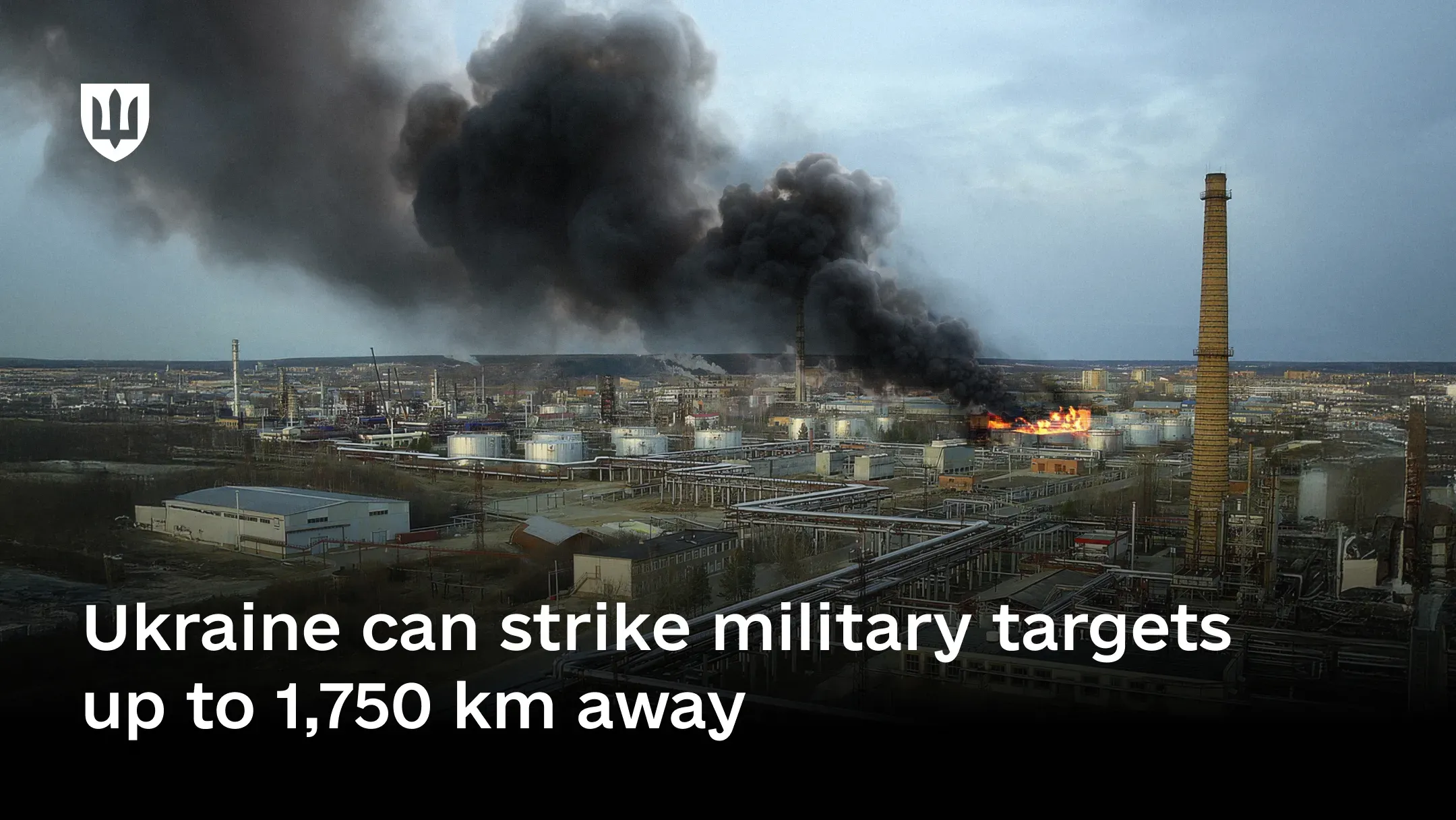
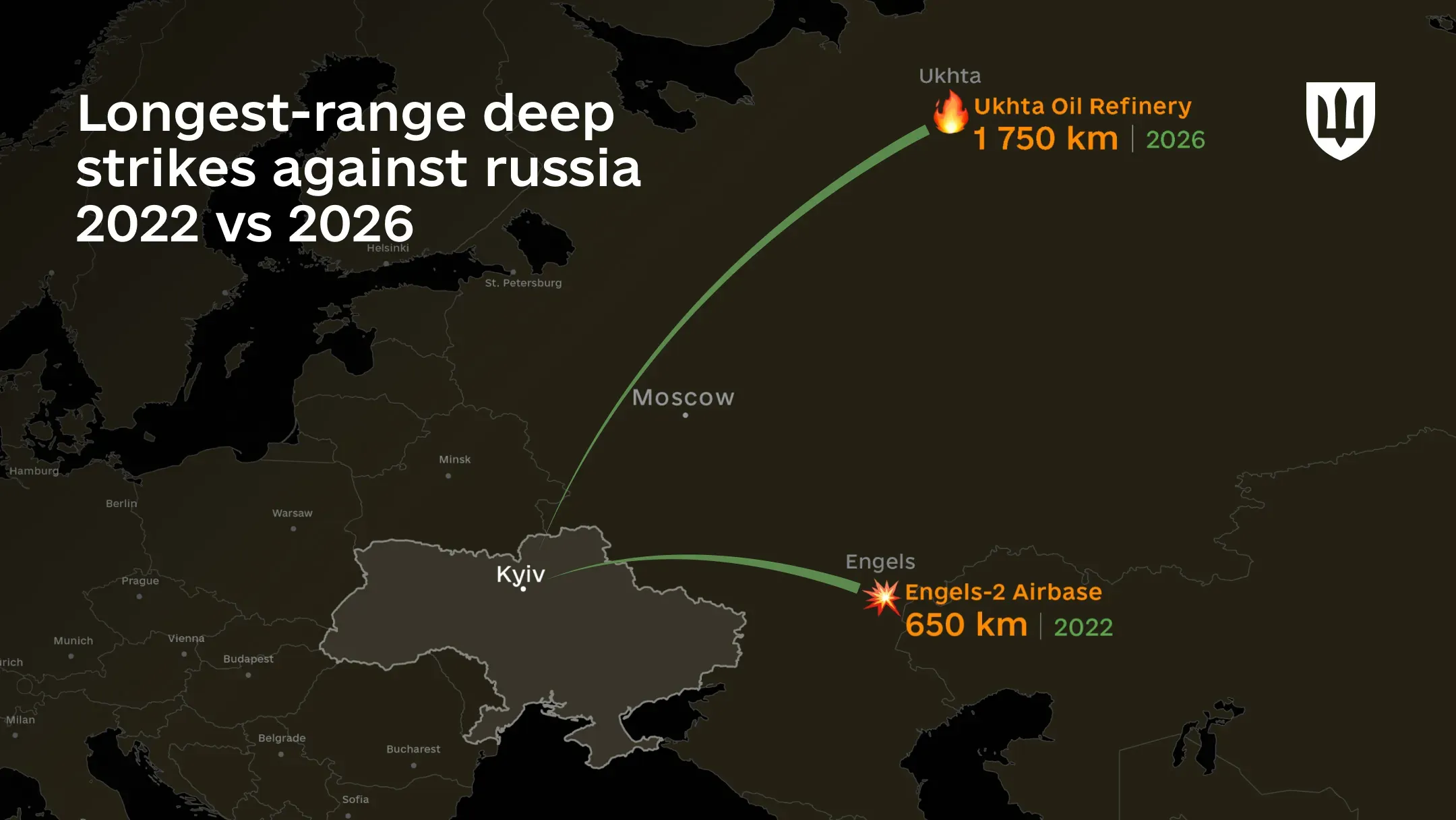
Since the onset of the full-scale invasion, the Defence Forces of Ukraine have increased the range of deep strike operations into the aggressor’s deep rear areas by over 2.5 times. Whereas in 2022 a military target was struck at a range of approximately 630 km, Ukraine’s long-range strike capabilities can now successfully strike the enemy’s war machine at a distance of around 1,750 km.
The Ministry of Defence highlights key deep strike operations against russia and underscores the importance of developing Ukraine’s long-range capabilities.
2022: Engels-2 Air Base, 650 km
In December 2022, Ukraine conducted a strike against Engels-2 Air Base in Saratov Oblast, one of the key airfields supporting russia’s strategic aviation. The strike resulted in damage to two Tu-95MS bombers, which are capable of carrying cruise missiles.
The Ukrainian deep-strike assets used against this strategic facility covered approximately 650 km, setting a record distance by the end of the first year of the full-scale invasion.
At the time, this operation represented the longest-range successful strike by the Defence Forces of Ukraine and exposed one of russia’s most notable air defense failures in 2022.
Notably, Dyagilevo Air Base in Ryazan Oblast, russia, at a strike range of approximately 500–600 km, was also targeted in the same timeframe.
2024: Ukraine expanded the geographic scope of long-range strike operations
In 2024, Ukraine expanded the geographic scope of its long-range strike operations to several strategic regions of russia:
- on April 2, a Shahed-type UAV production facility in the Alabuga Special Economic Zone was struck for the first time (1,200 km);
- on May 9, the Gazprom Neftekhim Salavat oil refinery was struck (1,500 km).
Thus, 2024 marked the year when Ukraine began transitioning to systematic long-range strikes against the infrastructure of russia’s war machine.
2026: Ukhta oil refinery, 1,750 km
In February 2026, units of the Security Service of Ukraine and other components of the Defence Forces of Ukraine conducted a strike against the Ukhta oil refinery in the Komi Republic, russia, at a range of approximately 1,750 km from the state border.
It is important to note that in 2026, the Defence Forces of Ukraine continue to conduct systematic strikes across both near and deep rear areas in order to compel the aggressor to peace. In particular, at a range of approximately 1,400 km, strikes were conducted against the Bashneft–Novoil and Bashneft–Ufaneftekhim refineries in Ufa.
As previously reported, the Defence Forces of Ukraine struck five strategic plants and ten oil refining facilities in russia in March. The operations spanned from temporarily occupied Crimea and the Donetsk and Luhansk Oblasts to deep rear regions of russia, including Leningrad Oblast.
The importance of developing Ukraine’s long-range capabilities
The development of deep strike capabilities constitutes one of Ukraine’s defense priorities, as emphasized by President Volodymyr Zelenskyy.
“Today, our deep strikes are no longer a sensation, although each time they remain both justified and welcome news. Today, our Ukrainian drones have fundamentally changed the way war is waged,” the head of state said, emphasizing that Ukraine has reached a high level in the production and use of missiles.
According to the President, russia’s losses resulting from long-range strikes are substantial.
“Certainly, we target what hurts russia. And it is indeed painful. We see the outcomes. Today, their losses are measured in tens of billions. These are critical losses for russia,” the President noted.
As Defence Minister Mykhailo Fedorov emphasized, peace in Ukraine will be achieved when the airspace is secured, russia’s military loses its offensive capability, and its economy is unable to sustain the pressure.
“We are working every day to make this happen. To ensure that each day of the war becomes a threat to russia’s existence,” the Minister of Defence said.