25 russian air defense and radar systems were hit: results of middle strike operations in April
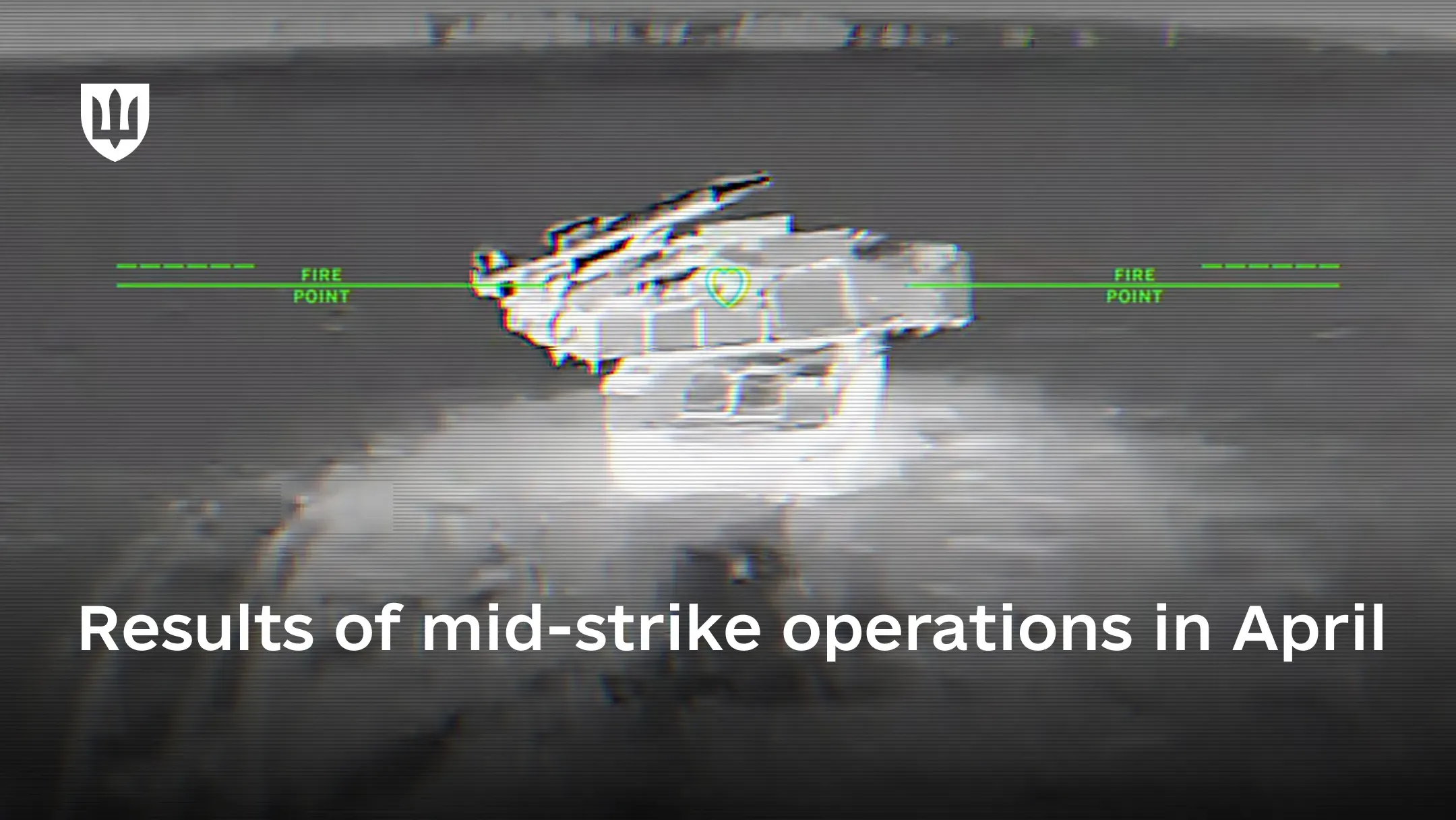
In April 2026, the Defence Forces of Ukraine continued to conduct middle strike operations against enemy logistics, depots, command nodes, air defense systems, and other components of russia’s offensive potential.
Throughout the month, our defenders systematically destroyed enemy rear support, “blinded” the enemy, and paralyzed its command-and-control system.
Following a recent meeting with Minister of Defence Mykhailo Fedorov, President of Ukraine Volodymyr Zelenskyy emphasized that middle strike is among the key priorities for the coming months.
“This year, the volume of contracted middle strike assets is already five times higher than last year, and we will continue to scale up both procurement and production,” the Head of State said.
The Ministry of Defence of Ukraine outlines the most significant russian losses resulting from strikes carried out by the Defence Forces of Ukraine over the past month.
25 russian air defense and radar systems hit
According to the General Staff of the Armed Forces of Ukraine, throughout April, Ukraine’s defenders struck at least 25 major enemy air defense and radar systems.
Radar systems constitute the largest share of russian losses in this category, with approximately 12 confirmed systems hit. These include Nebo, Kasta, MR-10 Ai-Petri, P-18, Podlyot, as well as the 96L6 radar, a component of the S-400 surface-to-air missile (SAM) system.
Surface-to-air missile (SAM) systems: Six units of three types were hit. These include Tor, Buk, and Osa.
Surface-to-air gun-missile systems: 2 Pantsir systems were hit.
Coastal Bastion missile systems were also struck.
Additionally, at Kacha airfield, an air defense command post and a ground-based radar interrogator Parol-4 (1L22)—an identification friend or foe (IFF) system and a critical component of integrated air defense coordination—were destroyed.
Strikes on Bastion systems in two separate areas of Crimea and Sevastopol limit the russian Black Sea Fleet’s ability to control the Black Sea domain.
The destruction of Tor, Buk-M2, Pantsir-S1, and Osa air defense systems directly opens strike windows for follow-on operations and degrades protection for enemy forces and infrastructure.
Over 55 russian military logistics and storage facilities destroyed
In April, the Defence Forces of Ukraine struck at least 23 ammunition depots, 19 materiel and technical supply depots, 13 fuel and lubricant depots, and one logistics hub. Overall, more than 55 strikes against depots across all categories were recorded in April.
The temporarily occupied territories of Donetsk and Zaporizhzhia oblasts account for the highest concentration of targets, together comprising more than two-thirds of all struck objects.
Strikes on ammunition depots are aimed at reducing the intensity of shelling. Destroying logistics support depots hampers the ability to sustain units’ combat effectiveness. Fuel logistics represents a key vulnerability in offensive operations: fuel echelons and POL depots support the maneuver of armored vehicles, artillery towing vehicles, and supply convoys.
33 russian UAV command-and-control infrastructure facilities struck
Over the month, approximately 24 UAV command posts and 9 drone workshops and storage facilities were hit, for a total of 33 targets.
Notably, a UAV storage site at Kirovske airfield in temporarily occupied Crimea was struck. The strike destroyed one Inokhodets UAV and damaged three more, each valued at several million US dollars. The enemy uses these systems for reconnaissance, patrol, and countering maritime drones (unmanned surface vehicles).
In addition, our warriors successfully hit storage sites for strike drones in the vicinity of Donetsk airport. The strike was conducted by units of the Air Force of the Armed Forces of Ukraine, employing SCALP cruise missiles and GBU-39 guided aerial bombs.
The destruction of enemy UAVs prior to their employment is particularly important and effective.
russian headquarters and command-and-control facilities: 17 strikes conducted
In April, approximately 17 command and observation posts, as well as command-and-control nodes of the occupying forces, were hit.
Particularly notable is the strike on the “Striletskyi” vessel traffic control post in Sevastopol. This strike degrades the maritime operational capability of the russian Black Sea Fleet and complements parallel strikes on Bastion systems.
Overall, strikes on command and observation posts and headquarters affect the enemy’s ability to coordinate tactical actions in real time.
Strikes on russian troop and equipment assembly areas
Notably, enemy Mi-28 and Mi-17 helicopters were struck near the settlement of Babky in Voronezh Oblast, russia.
Strikes on personnel were recorded in over 20 areas throughout the month.
Several of these—Sopych (Sumy Oblast) and Krasnooktyabrsky (Kursk Oblast)—are located on or near russian territory.
Additionally, weapons and equipment concentration areas were struck in Klimovo (Bryansk Oblast) and Novosvitlivka (in temporarily occupied Luhansk Oblast), as well as the “Kulykovskyi” training range in Novopetrivka in temporarily occupied Zaporizhzhia Oblast—a site used for training and unit integration of enemy forces, the targeting of which directly degrades the combat readiness of reinforcements before deployment to the front.
Middle strike operations in April: a comprehensive campaign to exhaust russia
In April, Ukrainian middle strike operations struck targets across the temporarily occupied territories of four oblasts, Crimea, as well as russia’s border regions—Belgorod, Voronezh, Kursk, Rostov, and Bryansk oblasts.
Strikes carried out in April formed a coherent campaign of attrition: “blinding” air defense systems open windows for further strikes, the destruction of depots limits the occupiers’ firepower and materiel resources, and the suppression of UAV command infrastructure and headquarters degrades the enemy’s ability to coordinate actions on the battlefield. All of this reflects a sustained, systematic effort that, month by month, reduces russia’s offensive potential.
As previously reported, Ukraine and Norway are establishing their first joint production of Ukrainian UAVs. Several thousand mid-strike drones are planned to be manufactured in Norway. All products manufactured under the project will be delivered to the Defence Forces of Ukraine.