Mobility, precision, and digital fire control: overview of the French CAESAR self-propelled howitzer
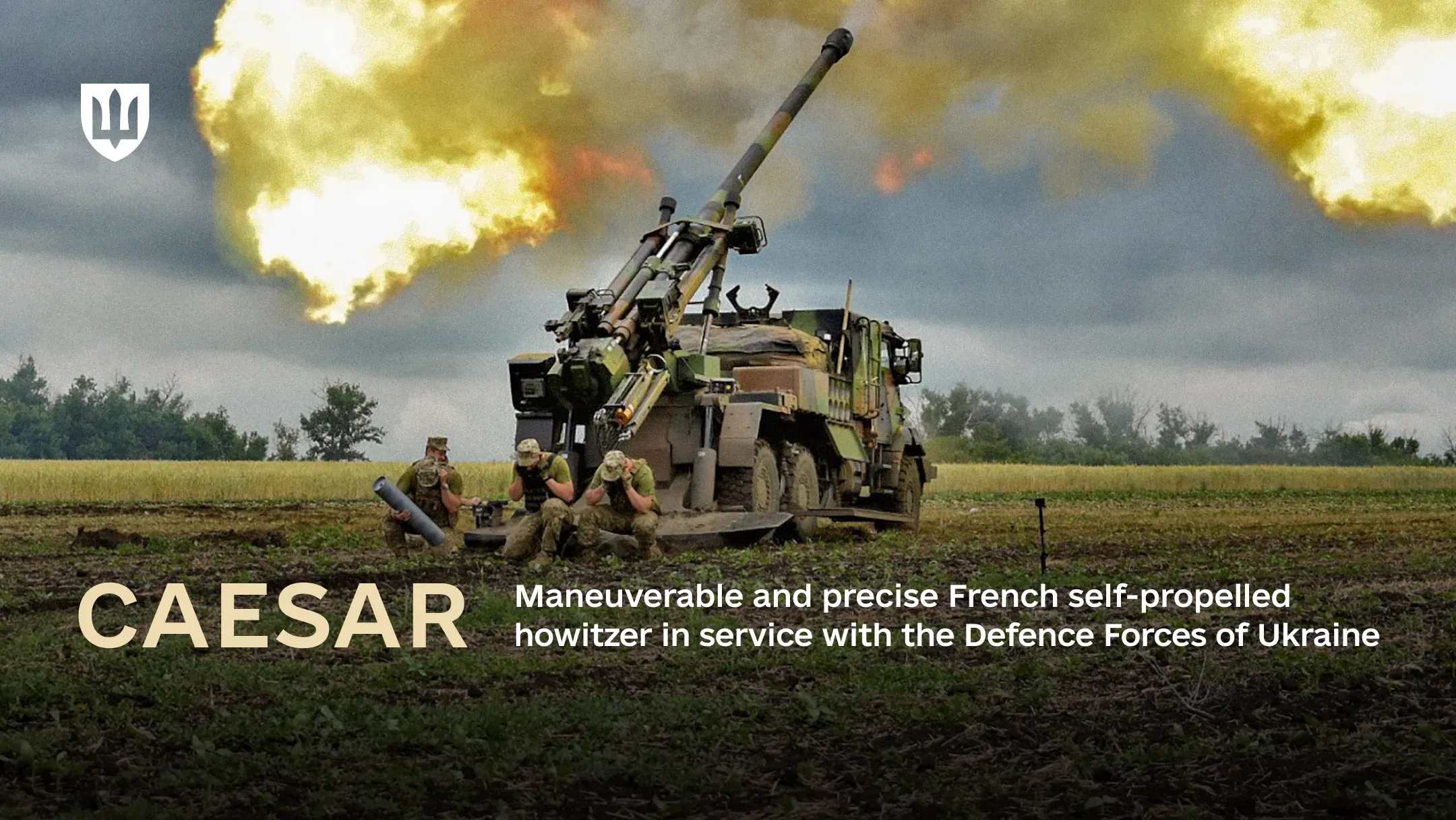
Throughout russia’s full-scale invasion, the Defence Forces of Ukraine have increasingly prioritised quality and precision over quantity in artillery operations. The French CAESAR self-propelled howitzer has emerged as one of the symbols of this transformation.
The Ministry of Defence of Ukraine highlights the key features and advantages of the CAESAR self-propelled howitzer.
Watch the Army Media report for more details on how the CAESAR operates on the front line.
CAESAR specifications: a mobile and powerful self-propelled howitzer
CAESAR is an acronym derived from the French Camion Équipé d’un Système d’Artillerie (“truck equipped with an artillery system”). This self-propelled howitzer combines the mobility of a wheeled truck with the firepower of a field howitzer.
Gun calibre and ammunition types
Calibre: 155 mm / 52 calibre. Ammunition load: 18 rounds carried on the system. Standard crew: five personnel, although the system can be operated by three service members if required.
The CAESAR can fire cluster munitions, high-explosive fragmentation munitions, illumination and smoke rounds, BONUS anti-tank guided munitions, as well as rocket-assisted projectiles.
Range and accuracy
The CAESAR system is capable of accurately engaging targets at ranges exceeding 40 km with ERFB Base Bleed ammunition, and at ranges exceeding 55 km with rocket-assisted or guided munitions.
During firing trials, an Excalibur guided projectile fired from a CAESAR destroyed two targets at a distance of 46 km with direct hits.
Mobility and protection: how fast can the CAESAR go and what armour does it have?
Road speed: 80 km/h; off-road speed: 50 km/h.
The CAESAR is equipped with an armoured five-person cab that protects against small-arms fire (up to 7.62 mm) and shell fragments (STANAG 4569 Level 2).
The cab is also equipped with air conditioning.
Chassis and dimensions: standard and larger versions
The standard 6×6 version weighs around 18 tonnes, making it one of the lightest systems in its class. Its length is 10.5 m, and its width is 2.55 m.
A CAESAR variant based on an 8×8 chassis is also available. In this configuration, the system weighs 32 tonnes and measures 12.3 m in length and 3.1 m in width.
CAESAR fire control system: integrating UAV data
The ATLAS automated fire control system enables the rapid integration of data from UAVs, COBRA radars, and forward observers.
This enables the CAESAR to fire its first round in less than one minute after halting, maintain a rate of up to six rounds per minute, and relocate before enemy counter-battery fire can respond.
Key advantages of the CAESAR: rapid deployment and digital fire control
Modern warfare requires artillery systems to deliver not only range and firepower, but also rapid deployment, fast engagement, and the ability to leave a position before enemy counter-battery assets can react.
Tactical mobility. The system’s manoeuvrability and speed help it evade attacks by russian loitering munitions and enemy artillery. Its wheeled chassis allows rapid movement along roads, eliminating reliance on rail transport or heavy transporters that many tracked systems require.
Rapid deployment. The CAESAR can execute a fire mission within 3–5 minutes, from taking up a firing position to delivering its first rounds. This is critically important in an environment saturated with enemy electronic warfare systems and drone reconnaissance.
Digital fire control system. The CAESAR is equipped with an automated fire control system integrated with IFADTS/AFADTS. Immediately after receiving a fire mission, the commander can enter firing parameters with a single touch, or the system can automatically calculate the optimal route to the firing position as well as the route for manoeuvre and withdrawal after the salvo.
Compatibility with NATO-standard ammunition. The CAESAR is compatible with standard 155 mm NATO ammunition, streamlining logistics and enabling the use of the most advanced guided munitions from different manufacturers.
Since 2022, Ukrainian artillery crews have accumulated unique combat experience operating the CAESAR, including in conditions for which the system was not originally designed, particularly in an environment shaped by the widespread use of drones and modern electronic warfare systems.
Earlier, the Ministry of Defence of Ukraine outlined the key features and advantages of the Ukrainian BTR-4 Bucephalus APC and the Polish Rosomak APC.