In just half a month, Ukraine’s Defence Forces struck over 20 targets supporting enemy air defense
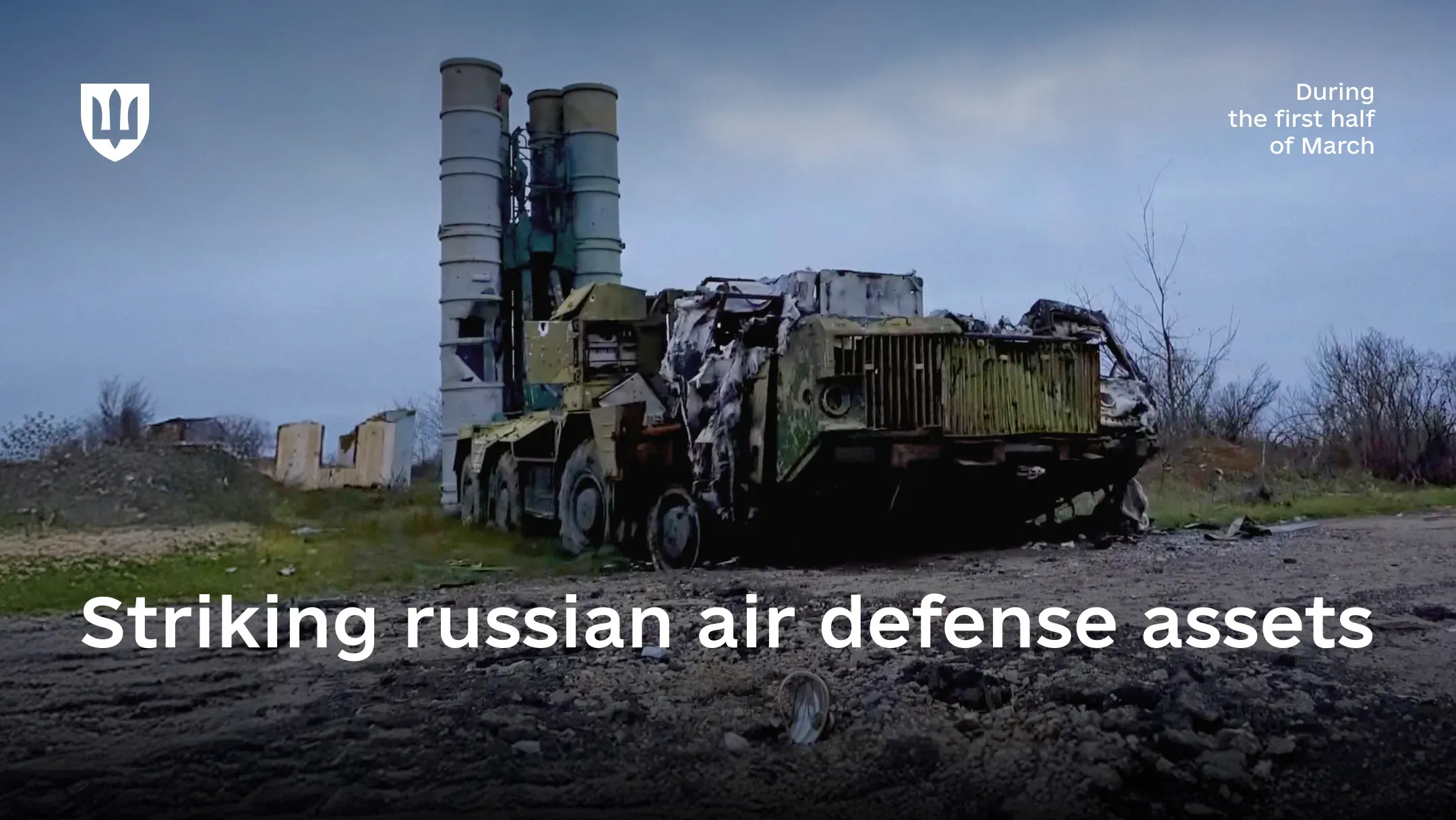
Between March 1 and 15, the Defence Forces of Ukraine struck more than 20 targets supporting russia’s air defense, including surface-to-air missile systems, radar systems, and major electronic warfare (EW) assets.
Each destroyed or disabled air defense system, radar station, or electronic warfare asset creates a “gap” in the enemy’s air defense, opening space for our missile strikes and air operations.
The Ministry of Defence of Ukraine outlines which targets were struck and the functions they performed.
Strikes on surface-to-air missile (SAM) systems
According to the General Staff of the Armed Forces of Ukraine, in just the first two weeks of March, the Defence Forces of Ukraine struck the following surface-to-air missile and combined gun-missile air defense systems:
- Pantsir-S1 (Yakymivka, Zaporizhzhia Oblast, and Novoozerne, Crimea) – protects against low-altitude aerial threats;
- Tor SAM system (Volnovakha, Donetsk Oblast, and Balashivka, Zaporizhzhia Oblast) – an all-weather short-range air defense system for protecting maneuvering ground forces;
- Tor-M1 SAM system (Korobkyne, Luhansk Oblast) – an upgraded variant optimized to counter precision-guided munitions and engage two targets simultaneously;
- S-300 SAM system launcher (near Strilkove, Kherson Oblast) – a component of russia’s primary medium- to long-range air defense system;
- Buk-M3 and Buk-M1 SAM systems (Lymanchuk, Luhansk Oblast, and Bahativka, Zaporizhzhia Oblast) – mobile air defense systems designed to engage maneuvering aerodynamic targets;
- S-300V SAM system launcher (Borovenky, Luhansk Oblast) – specialized for missile defense;
- S-400 Triumf SAM system launcher (Dalne, Crimea) – the most advanced long-range air defense system in russia’s armed forces.
Such losses are significant for russia. The destruction or degradation of SAM systems reduces the enemy’s ability to intercept missiles, making the occupiers’ rear bases more vulnerable.
Strikes on radar systems
Since the beginning of March, the following radar systems of russia’s armed forces have been struck:
- Radars for S-300 and S-400 systems (Mangush, Sadove, and Chervone, Donetsk Oblast; Novokrasnivka, Luhansk Oblast; Sevastopol, Crimea; Novorossiysk, Krasnodar Krai, russia) – the “eyes” without which the systems cannot detect targets;
- Podlet-1K (Vynohradne, Crimea) – detects aerial targets at low and very low altitudes;
- Kasta-2E2 (Liubyme, Luhansk Oblast, and Crimea) – an all-round surveillance radar for detecting low-observable targets;
- Yastreb-AV (Topoli, Luhansk Oblast) – the most advanced artillery reconnaissance system in russia’s armed forces;
- Sopka-2 (Crimea) – an airspace surveillance system;
- Nebo-U (Hvardiiske, Crimea) – enables long-range detection of aircraft and missiles;
- Protivnik and Parol systems (Libknekhitivka, Crimea) – mobile stations providing target designation for aviation;
- Valdai (Prymorske, Crimea) – a specialized radar system for detecting and countering small UAVs;
Without functioning radars, the enemy’s air defense becomes “blind,” making it harder for occupiers to respond in time to incoming threats.
Destruction or damage to electronic warfare (EW) systems
During the same period, the Defence Forces of Ukraine also struck major enemy electronic warfare and communications assets:
- ground relay station (Chornomorske, Crimea) – provided communications and control for strike UAVs;
- communications tower (Prymorsk, Zaporizhzhia Oblast) – a critical node for coordinating occupiers’ units;
- EW station (near Donetsk) – used to jam GPS signals and disrupt the navigation of our systems.
Striking these assets degrades enemy coordination and frees up the radio spectrum for more effective use by Ukrainian strike UAVs and precision-guided munitions.
To recap, during January and February 2026, the Defence Forces of Ukraine struck three major russian defense industry enterprises, as well as one of russia’s key missile test ranges and two large arsenals.