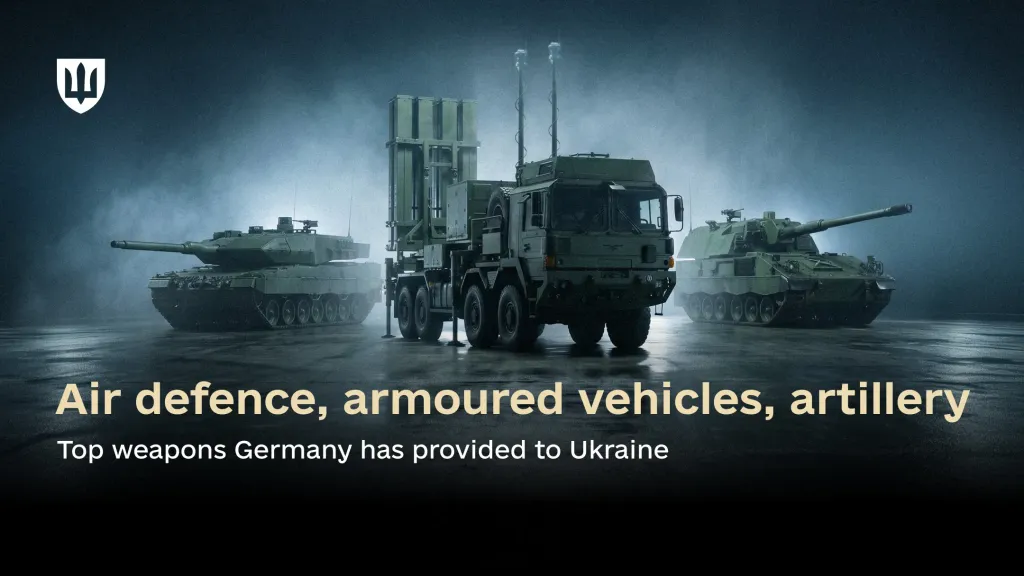
Over €34 billion in aid: how Germany became Ukraine’s strongest partner
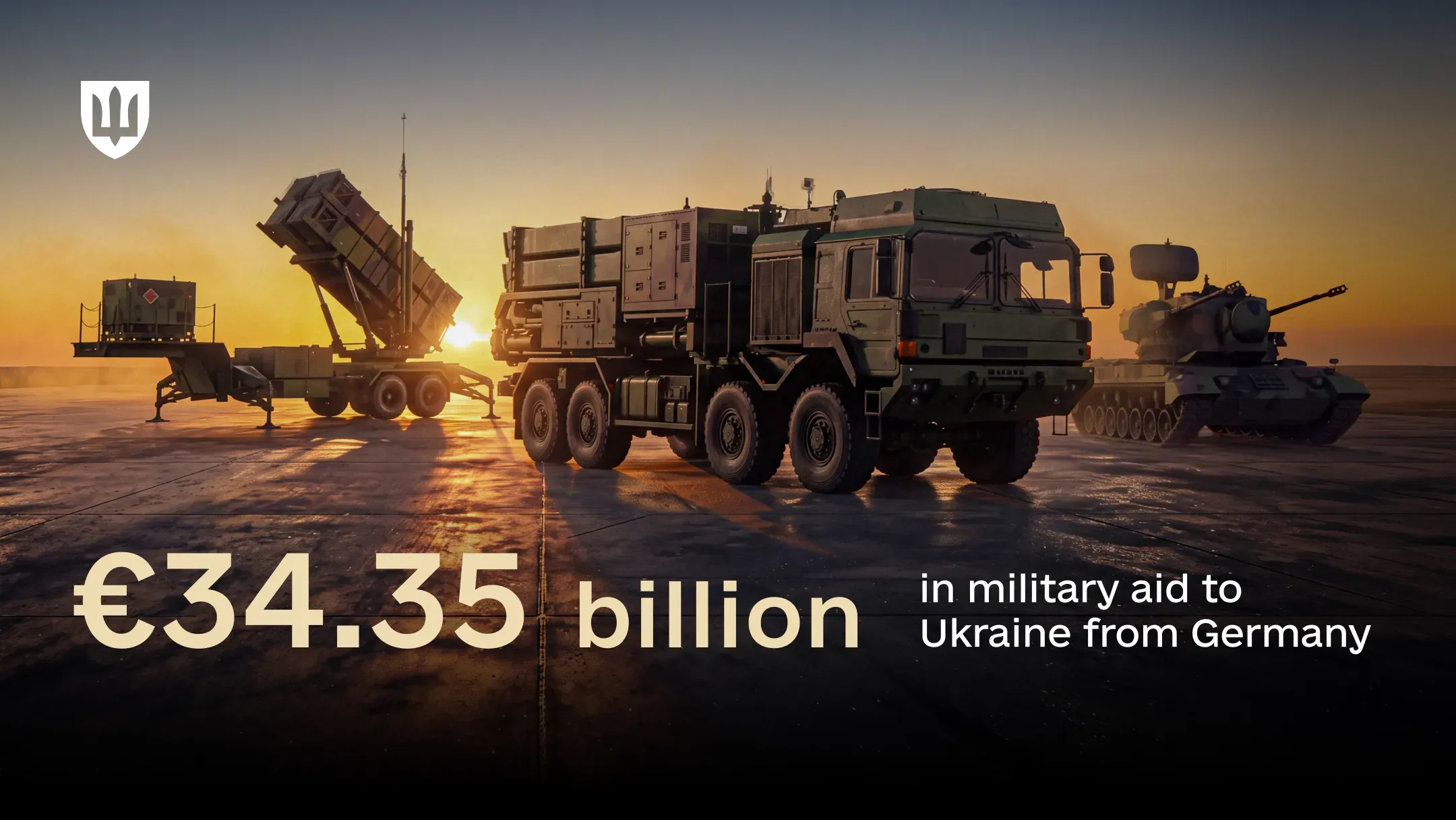
In 2026, the Federal Republic of Germany provided Ukraine with €11.5 billion in assistance, a third of all support from partners.
At the same time, our countries are developing a genuinely mutually beneficial partnership.
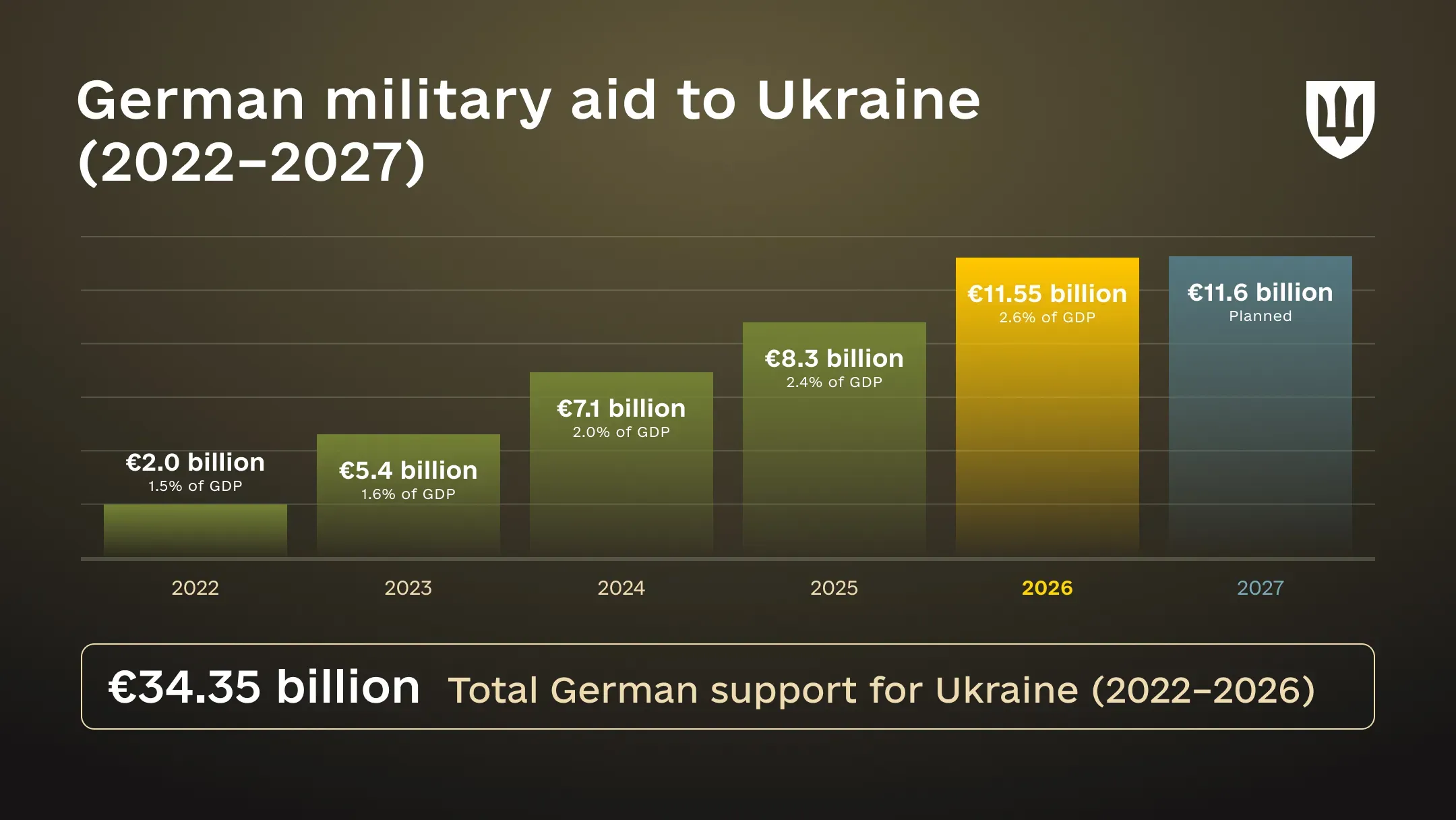
How Germany’s military aid has grown since the start of the full-scale war
Since 2022, Germany has steadily increased its military assistance to Ukraine:
- 2022: €2 billion (1.5% of GDP);
- 2023: €5.4 billion (1.6% of GDP);
- 2024: €7.1 billion (2% of GDP);
- 2025: €8.3 billion (2.4% of GDP);
- 2026: €11.55 billion (2.6% of GDP).
In five years, Germany’s annual support for Ukraine has grown nearly sixfold, and the total has reached €34.35 billion.
For 2027, Germany has planned €11.6 billion in assistance to our state.
Germany’s role in strengthening Ukraine’s air defence: IRIS-T, Patriot, and Gepard
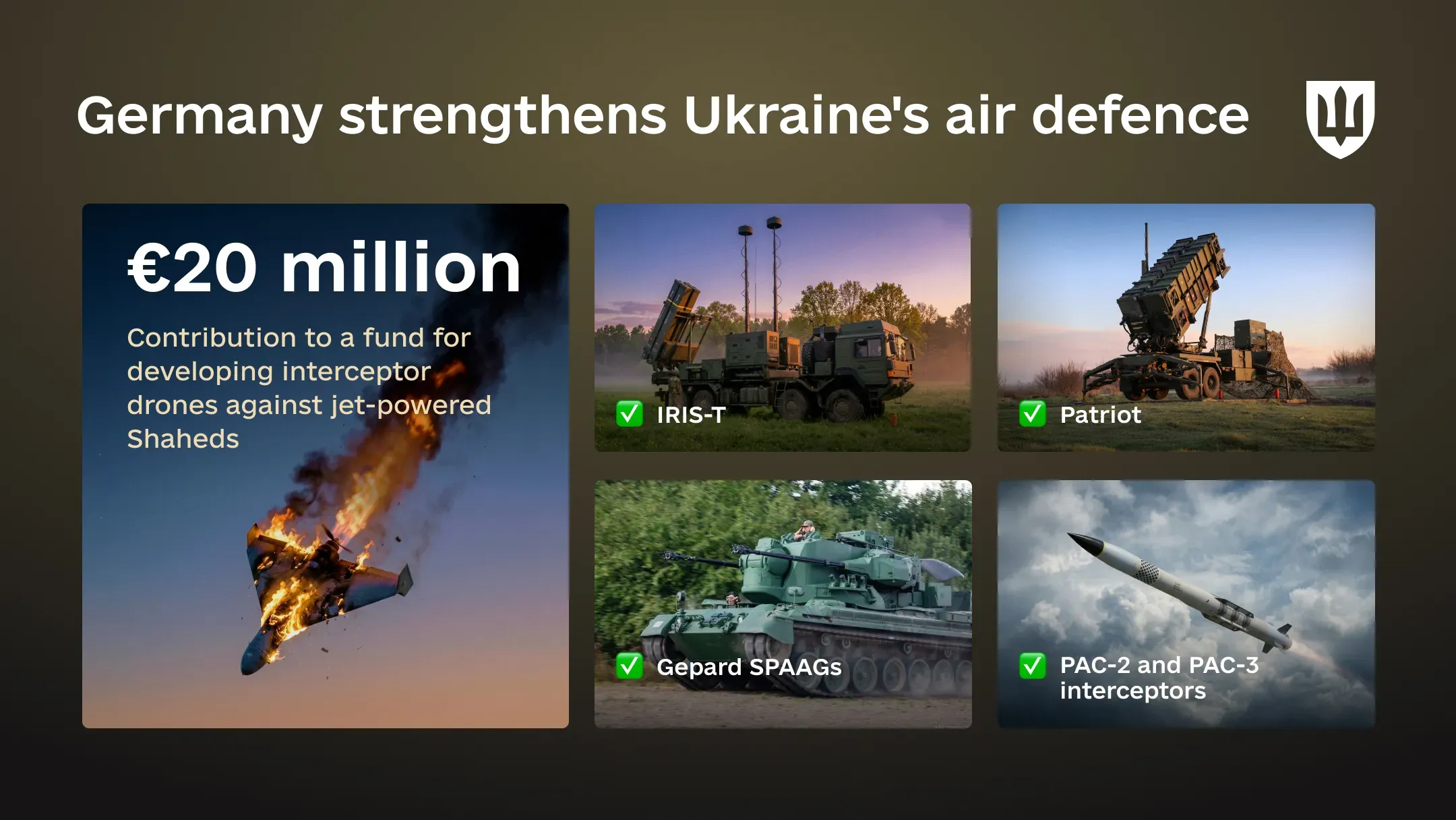
Germany consistently supports Ukraine’s air defence. In particular, its contribution to the fund for developing interceptor drones to counter jet-powered Shaheds has reached €20 million.
Germany also:
- supplies IRIS-T and Patriot systems and missiles;
- repairs PAC-2 missiles;
- has joined the procurement of PAC-3 missiles;
- provides maintenance for Gepard self-propelled anti-aircraft guns (SPAAGs).
This is an extremely important contribution to protecting Ukraine’s skies.
What strategic defence agreements Ukraine and Germany have signed
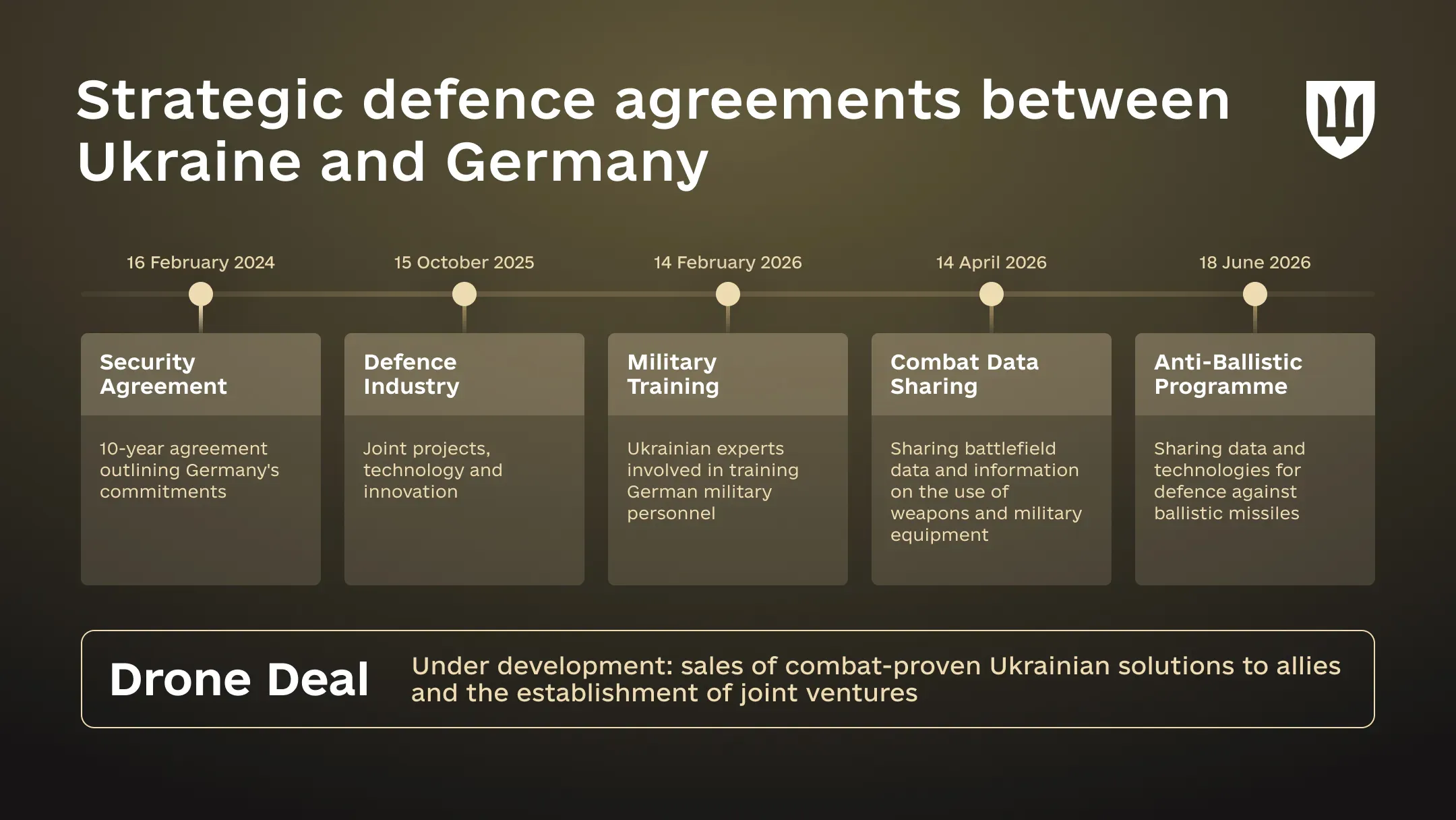
In 2024–2026, our states concluded a number of defence agreements. They cover security guarantees, industrial cooperation, and the exchange of combat experience and technologies.
The strategic documents and arrangements include:
- the Security Agreement of 16 February 2024, a 10-year document that sets out Germany’s security commitments to Ukraine;
- the Memorandum of Understanding on Defence Industrial Cooperation of 15 October 2025, which creates a mechanism for implementing joint projects in the defence industry, technology, and innovation;
- the arrangement of 14 February 2026 on integrating Ukrainian instructors into the training schools and centres of the German Armed Forces, which provides for involving Ukrainian specialists in training German service members;
- the arrangement of 14 April 2026 on data cooperation, which ensures the exchange and shared use of battlefield data and information on the use of weapons and military equipment between the two countries.
The Drone Deal initiative is still being worked out. Under it, Ukraine sells its combat-proven drones, technologies, and combat experience to allies and also builds joint ventures with them.
Another area is the anti-ballistic programme launched on 18 June 2026 under the industrial memorandum. The document focuses on exchanging data and technologies to develop solutions for protection against ballistic missiles.
Build with Ukraine: what the model offers for joint production
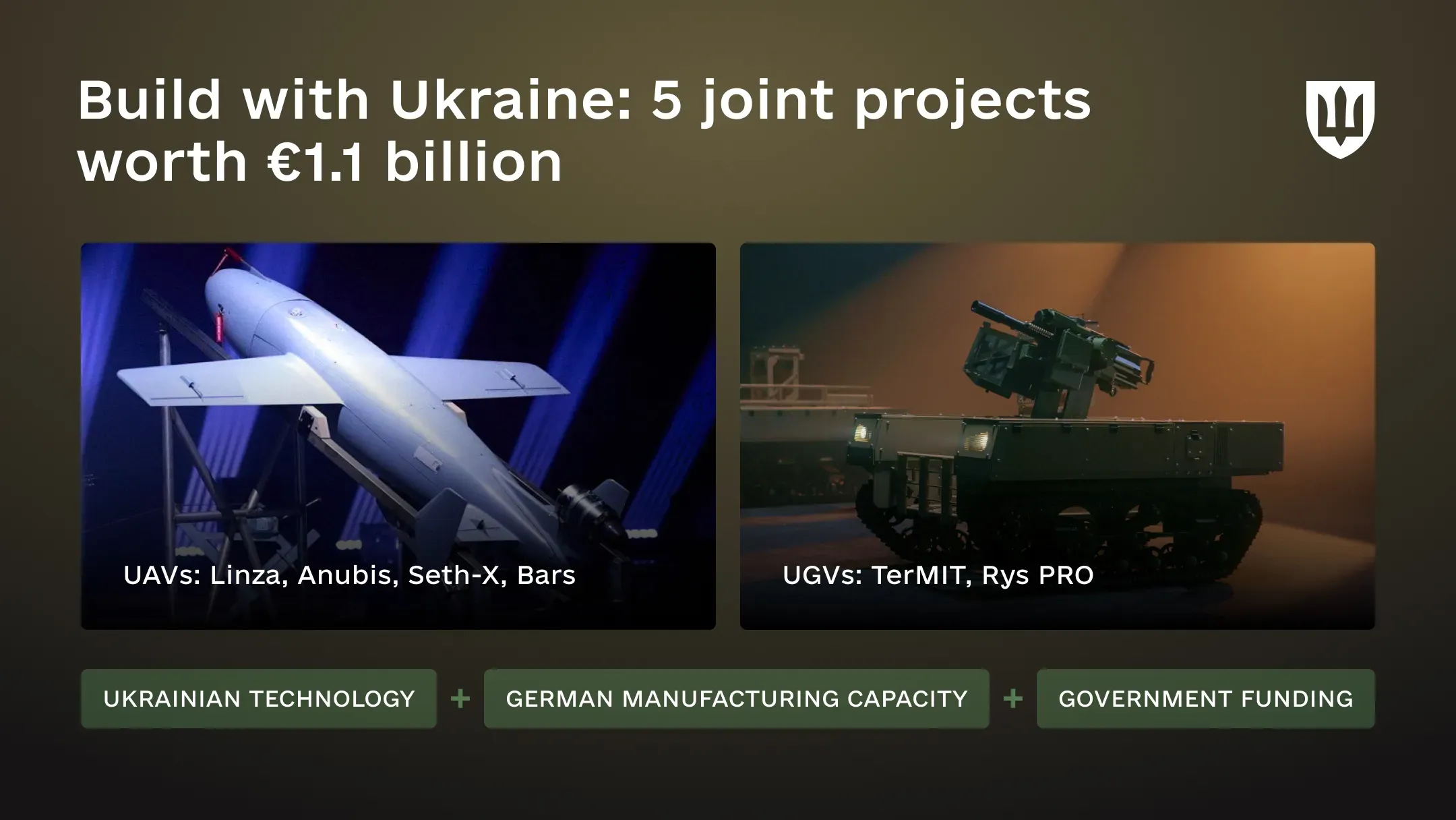
Germany remains the leader in setting up joint defence production projects with Ukrainian companies. Five projects with a total value of €1.1 billion have been launched under the Build with Ukraine model.
All five implementation agreements provide for the production of unmanned aerial vehicles (UAVs) and unmanned ground vehicles (UGVs) by joint ventures in Germany, funded by the German Federal Government:
- 17 December 2025: a project to set up a joint venture and produce Linza UAVs;
- 14 April 2026: a project to produce Anubis and Seth-X UAVs;
- 18 June 2026: a project to produce TerMIT UGVs;
- 8 July 2026: a project to produce Bars jet-powered UAVs;
- 21 October 2026: a project to produce Rys PRO UGVs.
This format makes it possible to combine Ukrainian engineering solutions with German production capacity and government funding.
Industrial partnership between Ukraine and Germany: from air defence to long-range strike systems
As part of their defence cooperation, Ukraine and Germany are also developing industrial partnerships aimed at jointly developing, producing, and maintaining weapons and military equipment.
In particular, Ukrainian and German companies are cooperating in several key areas:
- air defence: supplies of IRIS-T systems and missiles for them;
- unmanned ground vehicles: joint development, production, and maintenance of UGVs;
- unmanned systems: engineering partnerships and joint projects;
- artillery systems and air defence: cooperation on 25 mm and 40 mm air defence systems and 155 mm artillery systems;
- long-range strike systems: cooperation in the serial production and supply of such systems for Ukraine.
Overall, these partnerships cover both the procurement of finished products and the pooling of engineering expertise, technologies, and production capabilities of Ukrainian and German companies. This lays the foundation for long-term defence industrial cooperation between the two countries.
Which capability coalitions include Germany
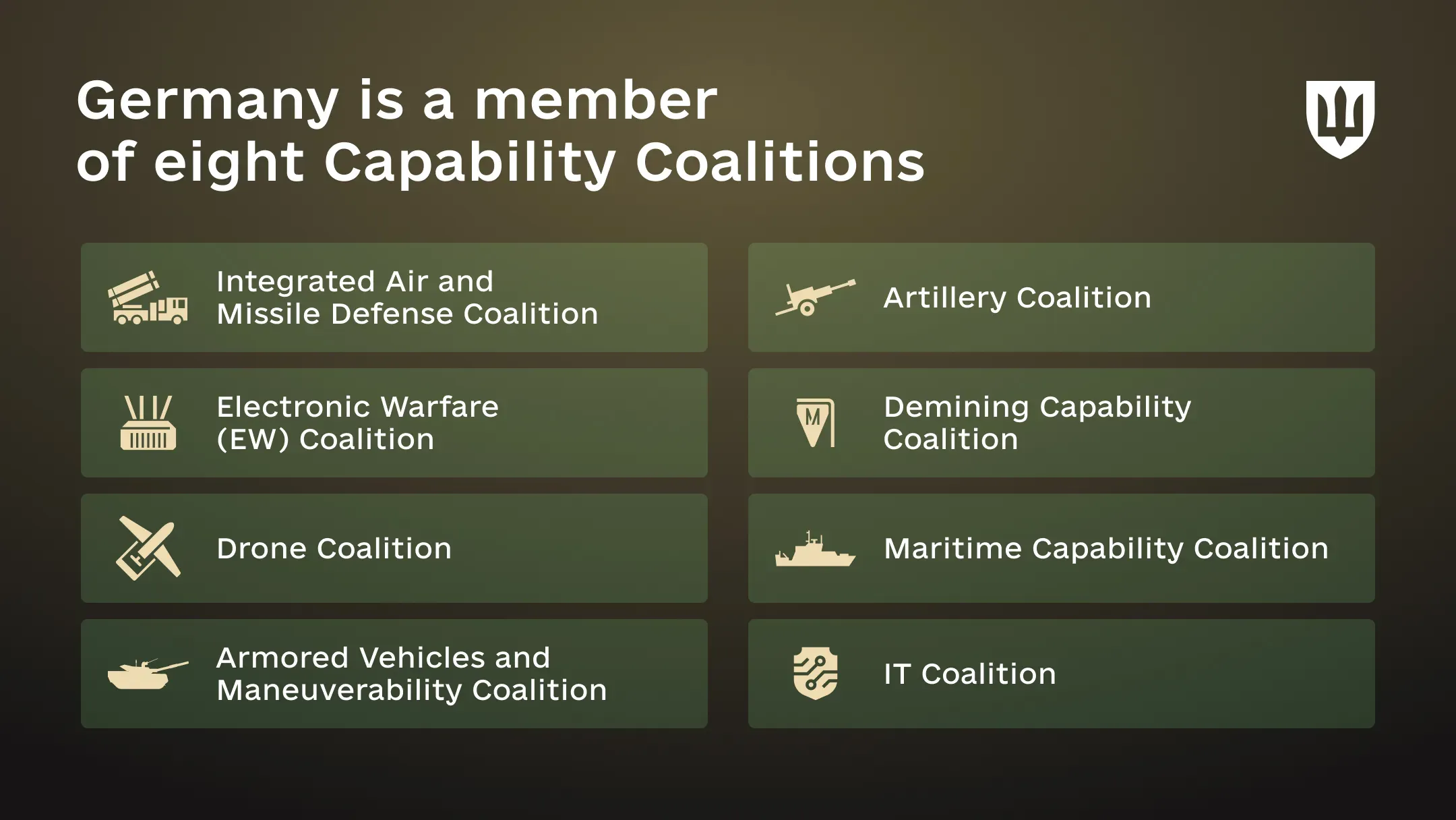
Germany is a member of eight capability coalitions. It leads three of them and participates in the other five.
In particular, Germany leads work within the Integrated Air and Missile Defence (IAMD) Coalition. Overall, Germany’s participation covers the following areas:
- Integrated Air and Missile Defence Coalition;
- Electronic Warfare (EW) Coalition;
- Drone Coalition;
- Armored Vehicles and Maneuverability Coalition;
- Artillery Coalition;
- Demining Capability Coalition;
- Maritime Capability Coalition;
- IT Coalition.
Germany’s broad representation in the coalitions makes it possible to coordinate procurement, equipment maintenance, and the development of the technological capabilities of the Defence Forces of Ukraine together with other partner countries.
Expected areas of cooperation between Germany and Ukraine in 2027
Germany’s 2027 budget includes €11.6 billion for military assistance to Ukraine.
The most promising areas of cooperation may include:
- drone production;
- air defence;
- the FREYJA anti-ballistic initiative.
The countries are also working to scale up joint production.
This includes:
- production in Ukraine of Leopard tanks, Marder infantry fighting vehicles (IFVs), Gepard SPAAGs, PzH 2000 self-propelled howitzers, Biber bridge layers, and Bergepanzer armoured recovery vehicles;
- joint production of unmanned aircraft systems (UAS) and UGVs in Germany under Ukrainian licences;
- joint work on air defence and missile weapons;
- supplies of German components and chassis for Ukrainian products;
- upgrading Ukrainian enterprises with German equipment.
As previously reported, the Ministry of Defence of Ukraine is working to expand cooperation with German defence companies, develop joint production, and attract financing for Ukraine’s defence industry.