The Government streamlines technology and weapons transfers under the Drone Deal by reducing the approval process to 30 days
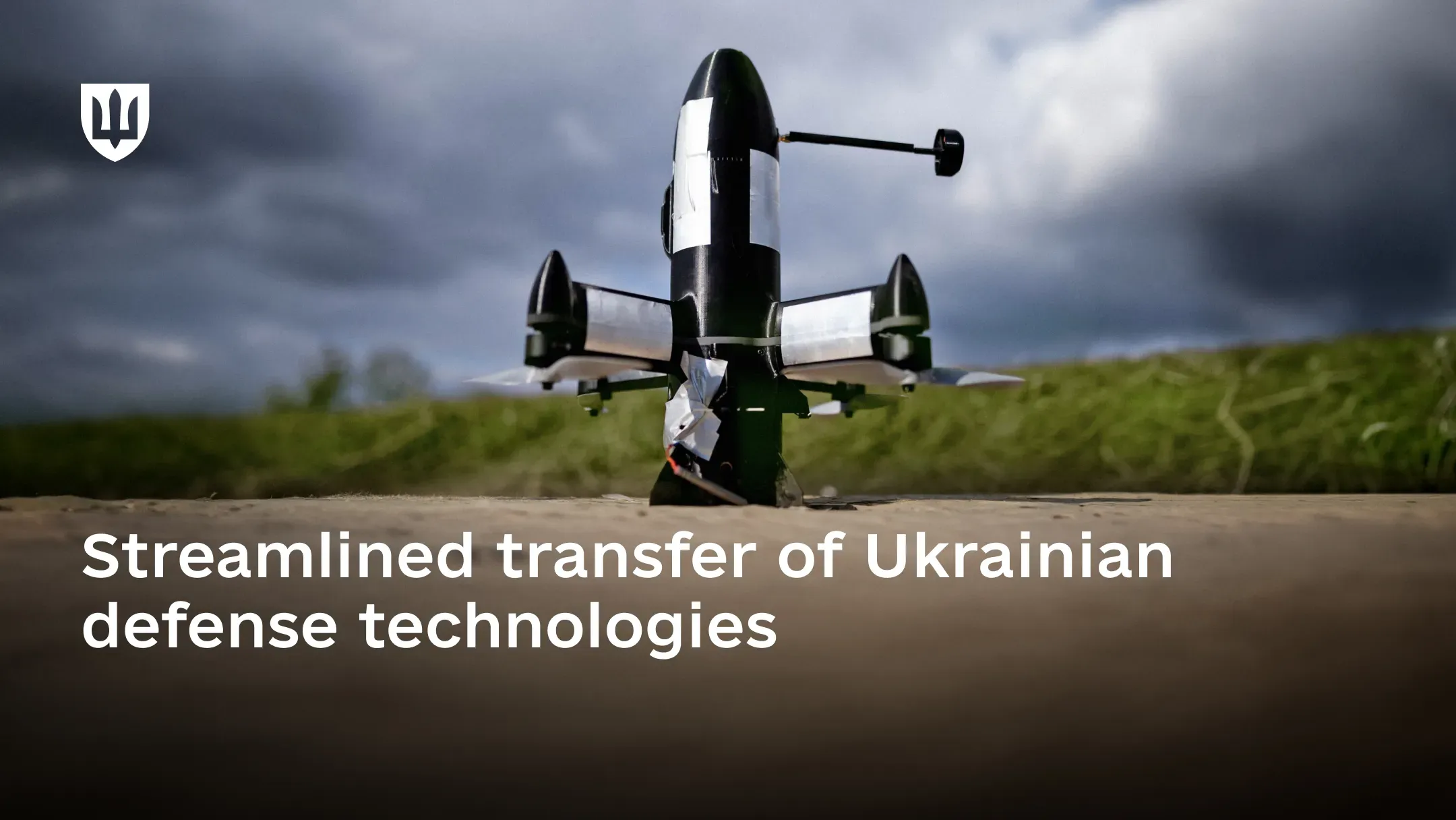
Countries participating in the Drone Deal framework that have signed agreements with Ukraine on the joint production, supply, or technology exchange of unmanned systems and other defense technologies will receive streamlined access to Ukrainian weapons, technologies, and technical documentation. Export permits will be issued by the State Service for Export Control of Ukraine within 30 days.
The Cabinet of Ministers of Ukraine has approved the relevant procedure.
The mechanism applies to transfers valued at UAH 15 million or more involving products adopted into service or codified by the Ministry of Defence of Ukraine, as well as military-purpose technologies for the production of such products.
The Ministry of Foreign Affairs of Ukraine will be responsible for compiling the list of partner countries to which the procedure applies, while the Ministry of Defence of Ukraine, together with other authorized government agencies, will be responsible for compiling the list of critical goods prohibited from transfer.
Guarantees and requirements applicable to foreign entities
State guarantees from the importing country are mandatory. Technology may be transferred only for use, without any transfer of intellectual property rights. Re-export or transfer to third parties will be permitted only with Ukraine’s written authorization. If the transferred items are modernized, the corresponding technical documentation must be submitted to Ukraine.
The foreign entity — whether an importer, end user, or intermediary — must meet the following requirements:
- not be subject to sanctions under the Law of Ukraine “On Sanctions,” and none of its owners, beneficiaries, or executives may be sanctioned individuals;
- not be listed as a person associated with terrorism or subject to international sanctions under Ukraine’s legislation on preventing money laundering and terrorist financing;
- not be under the control of the aggressor state or occupying state, or of the government bodies, legal entities, or citizens of either;
- not have citizens of the aggressor state or occupying state among its owners, beneficiaries, or executives;
- not hold corporate rights in a legal entity registered under the laws of the aggressor state or occupying state.
If products manufactured using Ukrainian technologies are supplied to third countries, 20% of their value will be paid to Ukraine’s state budget for granting re-export authorization.
Priority for meeting the needs of the Defence Forces of Ukraine
The procedure includes safeguards to ensure that Ukraine's defense needs are met. A permit may be denied if the Ministry of Defence of Ukraine or another state customer plans to procure the relevant goods for Ukraine's defense needs, or if the relevant goods are included on the List of Critical Goods.
At the same time, the manufacturer may guarantee that it can both fulfill the state contract as a priority and deliver the contracted export volume. In such cases, demand from state customers will not constitute grounds for denying the permit.
Failure to fulfill obligations to state customers in the defense sector constitutes grounds for suspension or revocation of the export permit.
Reference information:
Drone Deal is a framework for international defense-industrial cooperation between Ukraine and partner countries, focused on the joint development, production, and localization of unmanned systems, electronic warfare (EW) systems, missile capabilities, and other defense technologies. Unlike traditional military assistance, the framework is based on mutual investment, technology exchange, and the integration of Ukrainian innovations into partners' production capabilities. In return, Ukraine provides battlefield experience in employing unmanned systems and shares its engineering expertise. Drone Deal is implemented as part of the broader Build with Ukraine initiative.
As of the end of June 2026, Ukraine has concluded Drone Deal agreements with the Netherlands, Lithuania, and Latvia. The framework is also being implemented with Denmark. Similar agreements are being prepared with Germany, Canada, and the United States.