Not “revenge” for the Kerch Bridge: 109 russian attacks on Ukrainian bridges came first
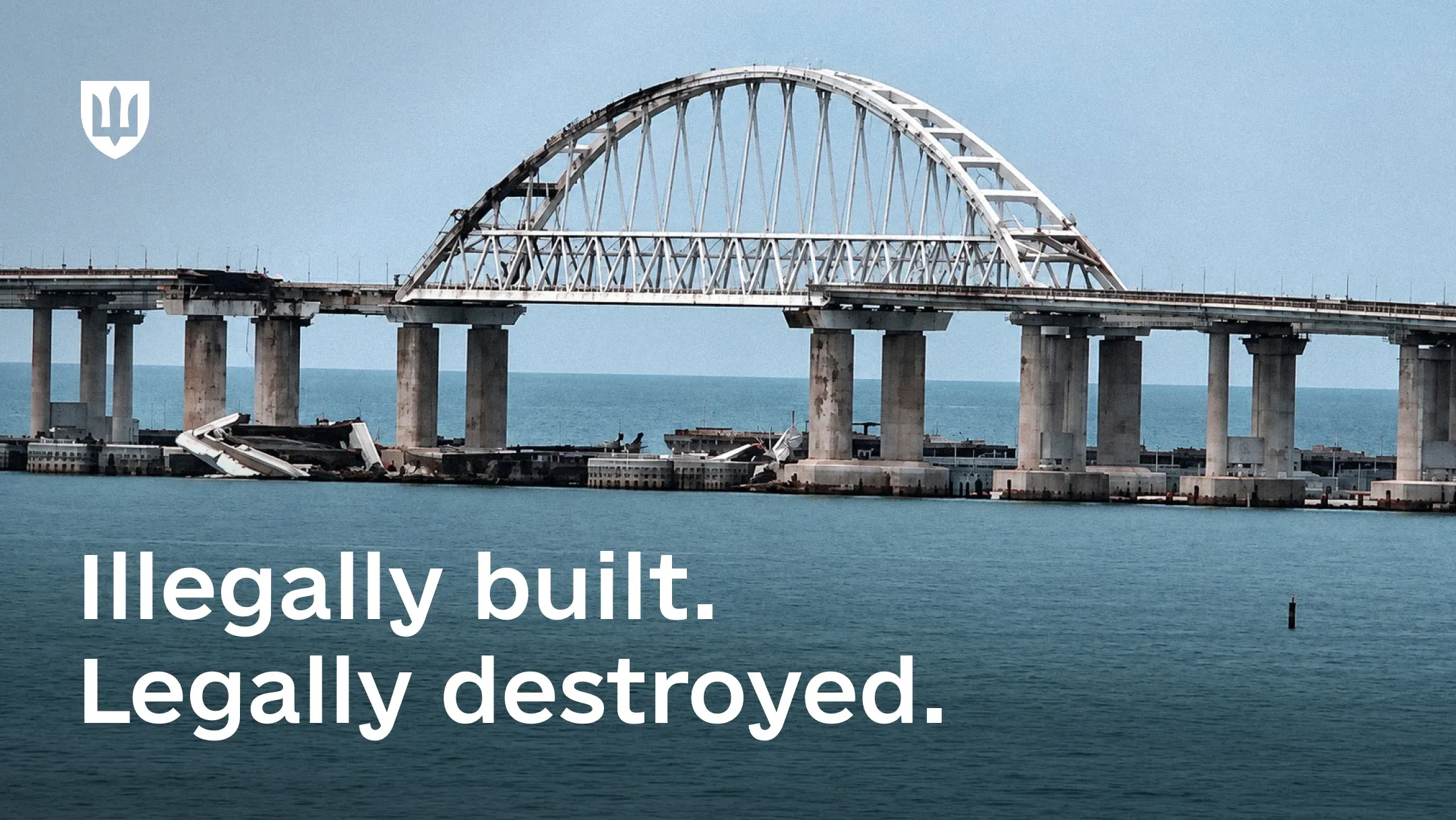
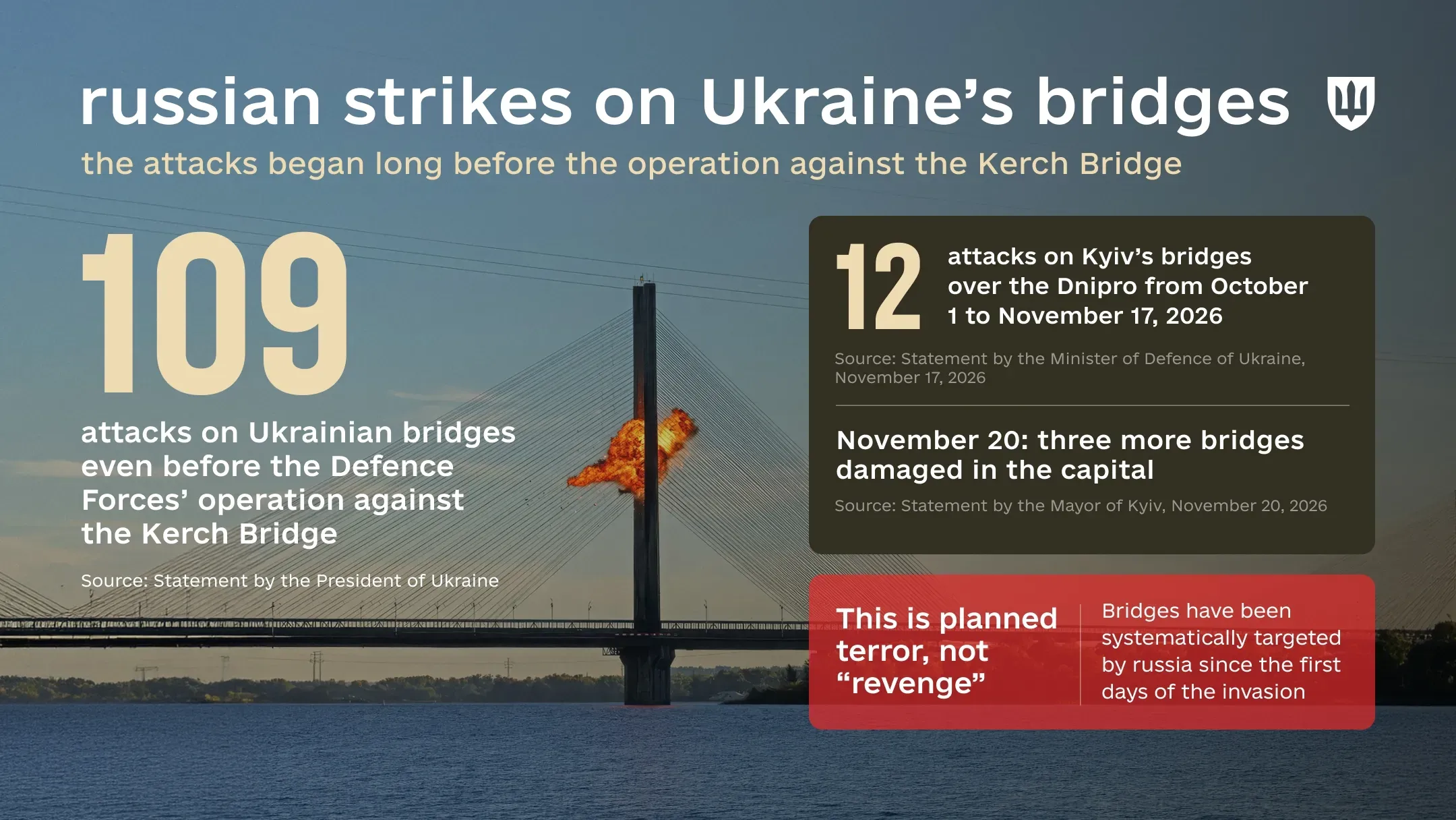
russia attacked Ukrainian bridges 109 times even before the Defence Forces of Ukraine’s operation against the Kerch Bridge. This is a relentless conveyor belt of planned terror.
The President of Ukraine, Volodymyr Zelenskyy, cited this figure at a meeting with UK Secretary of State for Defence Wes Streeting. This figure debunks the causal link the kremlin is trying to establish: the claim that attacks on Ukrainian cities are “revenge” for the strikes on the Kerch Bridge.
The Ministry of Defence of Ukraine explains why this version does not match the facts and how strikes by the Defence Forces of Ukraine differ from russian terror.
How long russia has been attacking bridges in Ukraine
Bridges have been an enemy target since the first days of the full-scale invasion. That is why these attacks cannot be explained as “revenge.”
In the fall, russia also began targeting the capital’s bridges. From October 1, 2026, a month and a half before the operation against the Kerch Bridge, it attacked Kyiv’s bridges over the Dnipro 12 times. Minister of Defence of Ukraine Evgeniy Khmara reported this in Brussels on November 17.
The attacks continued even after this statement. Overnight into November 20, russian ballistic missiles damaged three more of the capital’s bridges: Podilsko-Voskresenskyi, Darnytskyi, and Pivdennyi. This is a continuation of the same campaign that russia has been waging since October 1.
Why russia’s strikes are not retaliation for the Kerch Bridge operation
The logistics system supplying missiles and attack drones to russian airfields and launchers operates continuously. The enemy is always ready to strike according to its own plan and needs no particular news event as a pretext.
The targets do not change either. Despite calls for de-escalation, russia strikes civilian crossings and large industrial facilities. These include a metallurgical plant in Kryvyi Rih that employs thousands of civilians.
The kremlin’s “revenge” narrative is merely a convenient smokescreen for planned terror. The real purpose of this myth is to shift the blame for the aggression onto those defending themselves. It is also meant to make Ukraine and its partners fear their own successful strikes on the occupier’s military logistics.
The difference between the Kerch Bridge and the bridges russia attacks
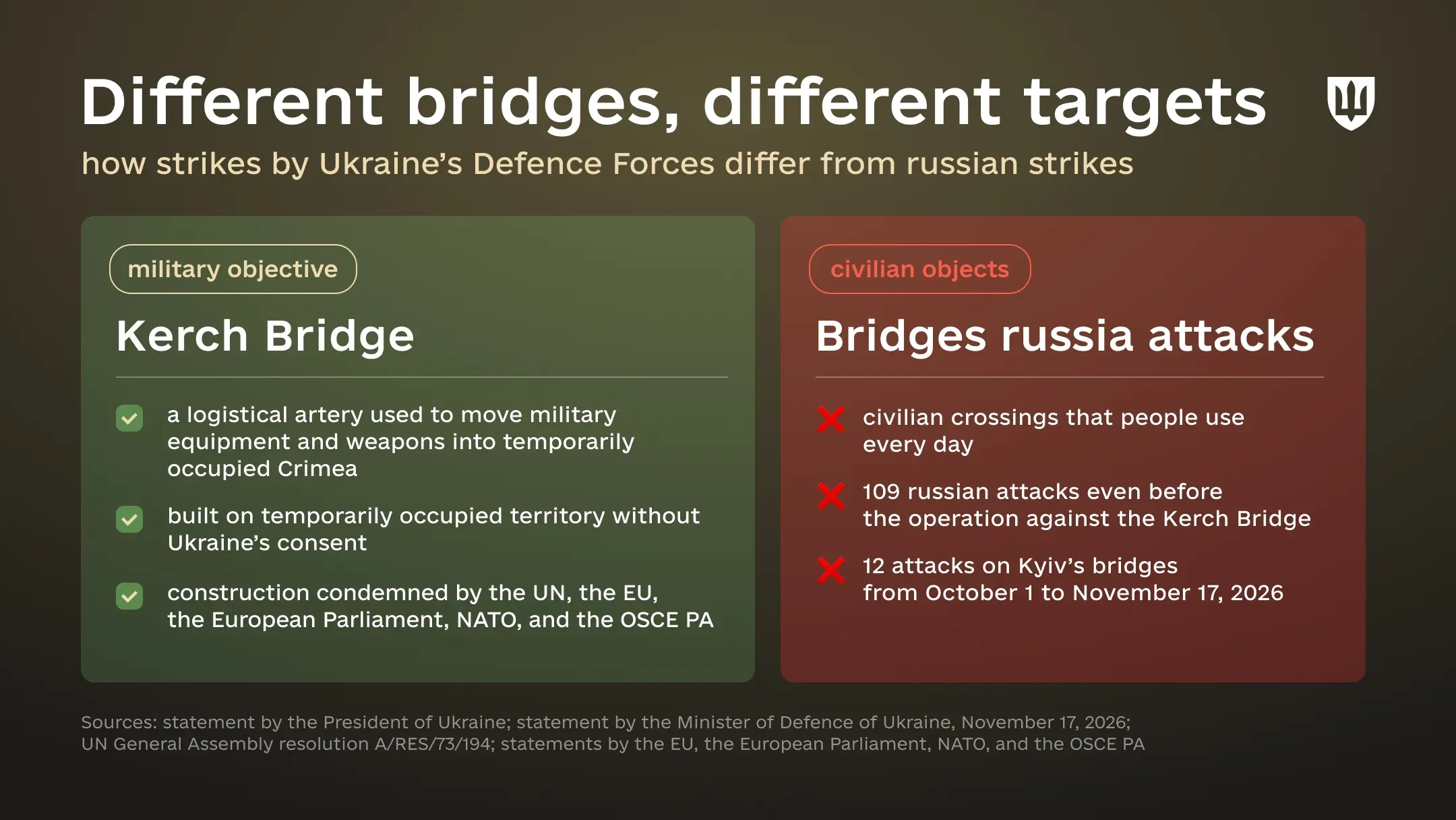
The distinction is fundamental: it is the difference between striking a military objective and committing acts of terror. russia systematically uses the Kerch Bridge as a logistical artery to move armored vehicles, artillery, and ammunition into temporarily occupied Crimea. Numerous videos and open sources confirm this.
russia itself released some of these videos. On February 16–17, 2022, its Ministry of Defense and the Zvezda TV channel showed trains carrying tanks, infantry fighting vehicles, and self-propelled artillery on the railway section of the bridge. On October 9, 2022, UK Defence Intelligence noted that the rail crossing had played a key role in moving heavy military vehicles and equipment to the southern front.
The russian Ministry of Defense’s own footage thus refutes putin’s November 19 statement about an “exclusively peaceful facility.”
More evidence emerged after the full-scale invasion began. In August 2022, Krym.Realii, a project of Radio Free Europe/Radio Liberty, published a video of trains carrying tanks and self-propelled howitzers at Taman station near the entrance to the bridge. In March 2024, Head of the Security Service of Ukraine (SSU) Vasyl Maliuk said that 42 to 46 trains carrying weapons and ammunition had crossed the bridge every day before Ukraine’s successful strikes.
For russian forces in Crimea and on the left bank of Kherson Oblast, the bridge is the main supply artery, and they have no comparable routes. The land corridor through the occupied territories is under the fire control of the Defence Forces of Ukraine. According to Ukrainian Navy spokesperson Dmytro Pletenchuk, russia has nothing that can replace the bridge as a transport link. Destroying the bridge therefore means isolating a large group of troops.
The bridge was also built illegally: on temporarily occupied territory and without Ukraine’s consent. Several international institutions condemned its construction, including:
- the UN General Assembly;
- the European Union;
- the European Parliament;
- NATO;
- the OSCE Parliamentary Assembly.
In its resolution dated December 17, 2018, the UN General Assembly noted that the bridge facilitates the further militarization of Crimea.
Strikes on the Crimean Bridge under international law
International humanitarian law distinguishes between civilian objects and military objectives. Additional Protocol I to the Geneva Conventions, to which both Ukraine and russia are parties, provides the definition.
…military objectives are limited to those objects which by their nature, location, purpose or use make an effective contribution to military action and whose total or partial destruction, capture or neutralization, in the circumstances ruling at the time, offers a definite military advantage.
A bridge used to move equipment and ammunition meets this definition. EUvsDisinfo, a project of the European External Action Service, classifies russian propaganda’s claim about a “purely civilian object” as disinformation. According to the project, a bridge that serves as the main military supply route falls under the definition of a military objective.
Ukraine strikes targets on its own territory temporarily occupied by russia. Ukraine has been compelled to defend itself, and its right to do so is enshrined in Article 51 of the UN Charter. NATO describes Ukraine’s right to self-defense as inherent.
What actually stops russian strikes
The Defence Forces of Ukraine are severing the enemy’s logistical artery, whose military use has been confirmed, while russia strikes civilian bridges and industrial plants. The experience of the full-scale war proves that Ukraine’s caution does not deter russia. Only air defense and the destruction of enemy military logistics and launch platforms stop russian missiles and drones.
The enemy’s attacks on bridges are therefore not a response to actions of Ukraine’s Defence Forces. Rather, these attacks are part of a plan of terror that the kremlin has been carrying out since the first days of the invasion.