Food terror: how russia attacks Ukraine’s industry facilities, warehouses, and grain elevators
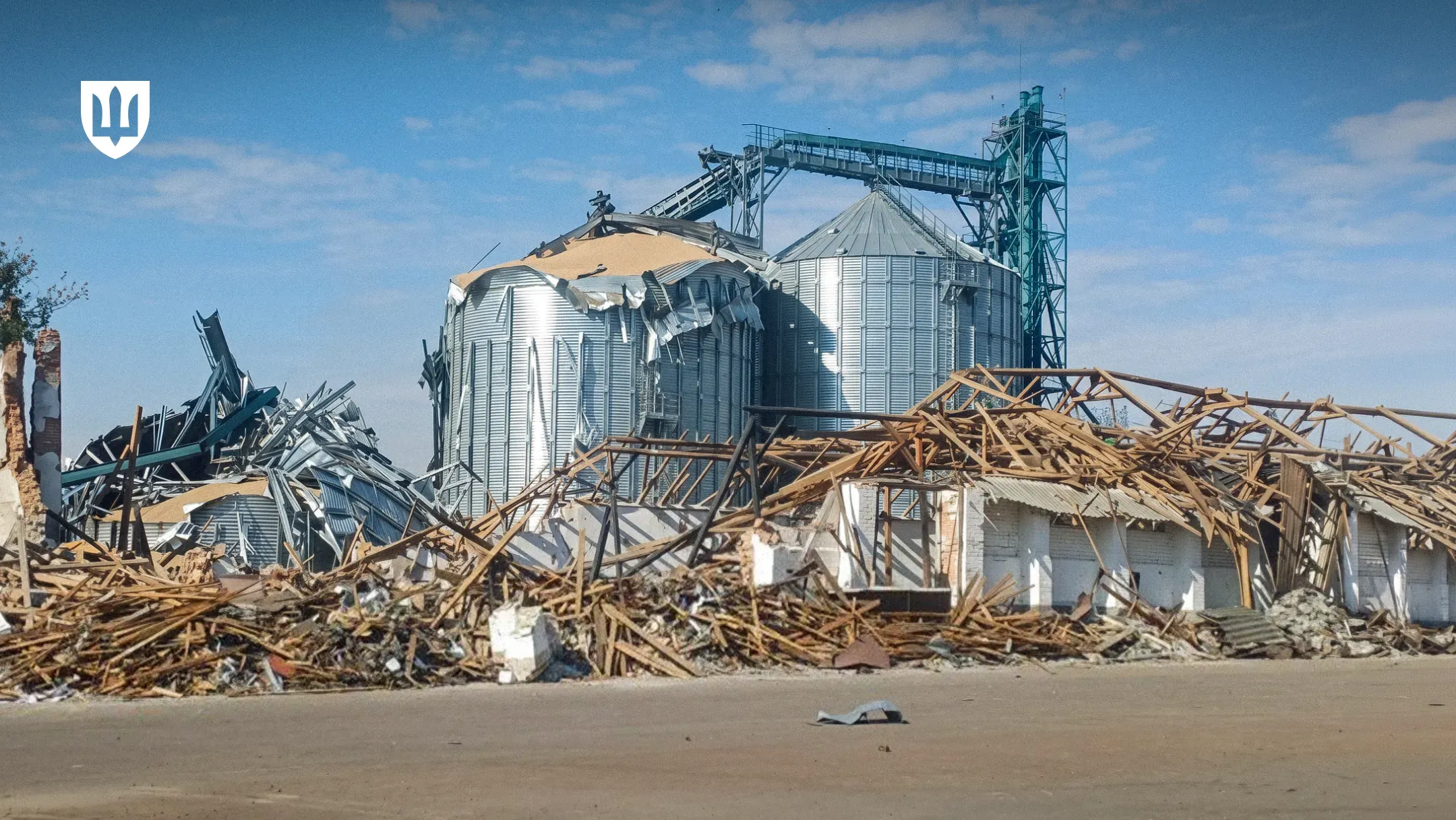
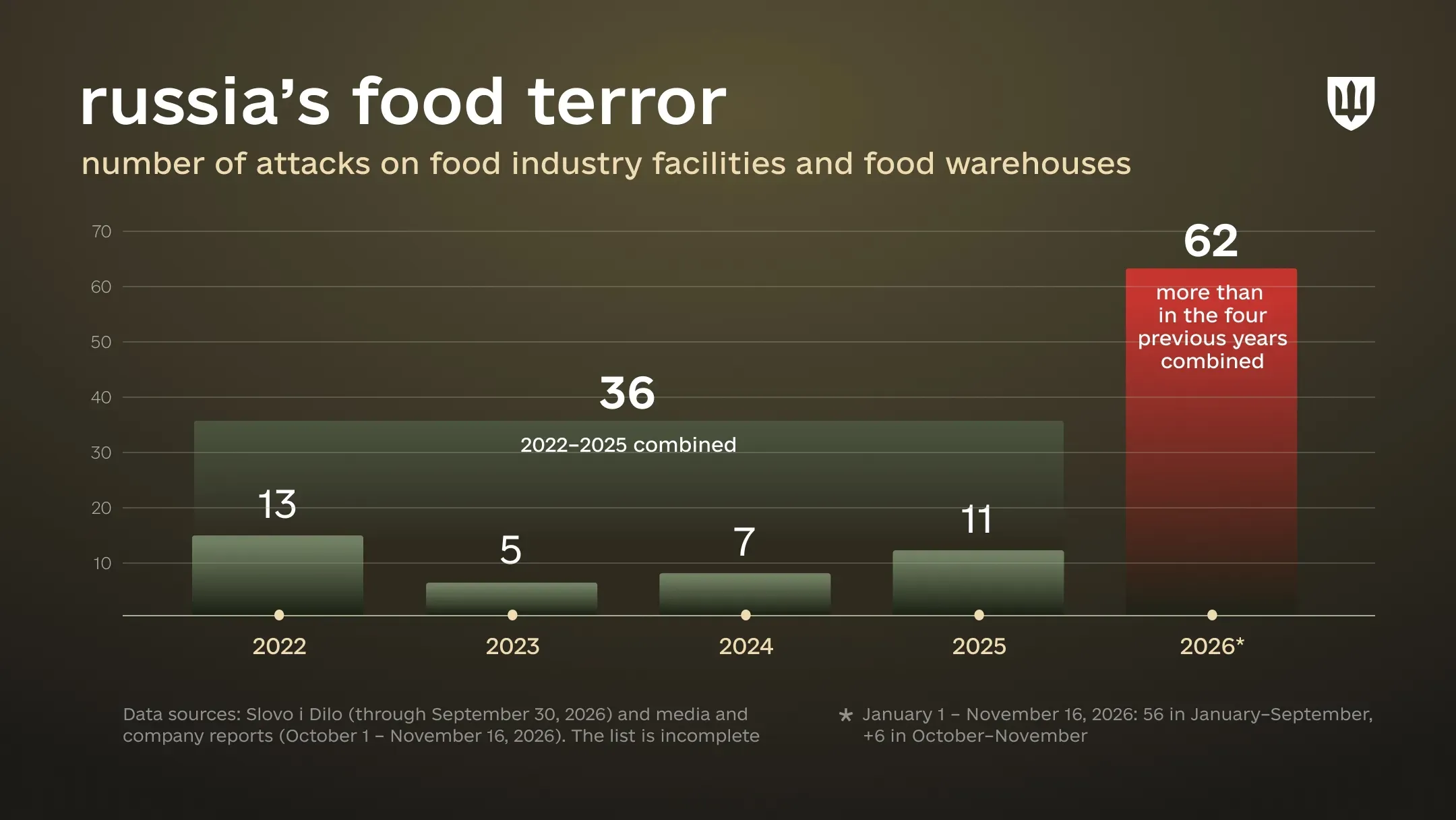
In 2026, russia has sharply increased the number of strikes on Ukraine’s food industry. At least 62 attacks on plants and food warehouses have been recorded since the beginning of the year, nearly twice as many as in all previous years of the full-scale invasion combined. Such strikes violate international humanitarian law.
Even without a direct hit, production can come to a halt: some enterprises stop operating because of blackouts and the threat of new strikes.
How many times has russia attacked Ukraine’s food industry facilities?
The count covers targeted attacks on food industry facilities, food and cold storage warehouses, and logistics centers. It is based on media and company reports, so the list is incomplete: some of the facilities hit are not named for security reasons.
Plants are not the only facilities under attack. On November 12, Viacheslav Chaus, Head of the Chernihiv Regional Military Administration, reported more than 100 hits on farms and agricultural enterprises in the region since the beginning of the year.
On November 10, a source in the Defence Intelligence of Ukraine told Ukrinform that russia was preparing strikes on grain elevators, grain warehouses, vegetable oil plants, dairy plants, meat processing plants, and poultry farms. According to the intelligence service, the goal is to destabilize Ukraine’s food security.
What are the consequences of russian strikes for Ukraine’s food industry?
The consequences of the attacks in the first half of November range from a damaged production workshop to a completely destroyed production facility.
Third time this year: a strike on an international holding’s plant
Ukraine’s agricultural sector is export-oriented, so many enterprises belong to international holdings. They include the Oleina plant in Dnipro, which belongs to one of the world’s largest grain traders. According to Reuters, it is among Ukraine’s five largest oilseed processing plants, with a capacity of up to 1,600 tonnes of oilseeds per day.
On November 16, this plant was attacked for the third time this year. In January, around 300 tonnes of sunflower oil spilled onto the city’s roads after a drone strike.
In September, a strike killed two people, and the plant was shut down. This time, according to the company, a section of the production facility was damaged, and no employees were injured.
“This attack was not a mistake – it was deliberate,” Ukraine’s Minister of Foreign Affairs, Andrii Sybiha, said after the January strike.
Complete destruction of production facilities
On the evening of November 16, jet-powered drones struck a Korolivskyi Smak enterprise in Kirovohrad Oblast. The fire burned all night and destroyed products, production facilities, and premises. One person was killed.
“As of today, there is no possibility of resuming operations,” the company said the next day.
Three days before the strike, this enterprise had already announced that it was shutting down its plants because of blackouts and the threat of attacks. “The hardest part of this situation is that we are forced to leave people without work. Many have worked with us for years, and we understand that behind every employee is their family,” the company explained at the time.
Production halted with or without direct hits
On November 11, trilateral talks between Ukraine, the United States, and russia concluded in Abu Dhabi. Less than a day later, a drone hit an oil extraction plant owned by Kernel, Ukraine’s largest sunflower oil producer.
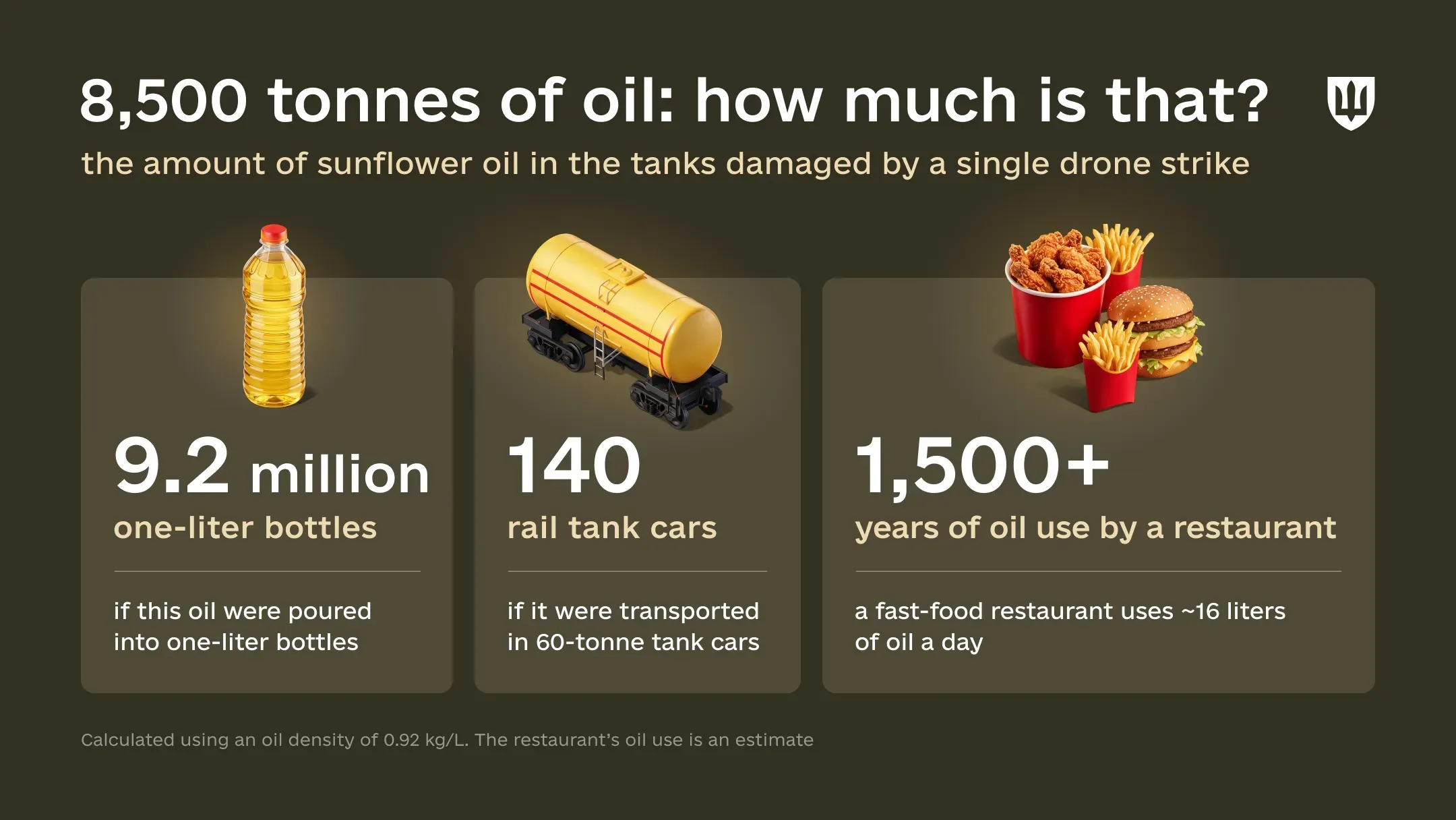
Four storage tanks holding 8,500 tonnes of oil were damaged. The oil spilled over an area of more than 3,500 square meters.
On the evening of the same day, the company shut down all eight of its oil extraction plants and suspended oilseed procurement.
Other production facilities are shutting down without a single hit. On November 17, two bread and pasta producers in Kremenchuk suspended operations: with constant power outages and the threat of missile and drone strikes, they cannot operate reliably. They have not said when production will resume.
Why do strikes on food infrastructure violate international law?
Strikes on food supplies and food industry facilities cannot be considered separately from strikes on the energy system and water supply. They are components of a single deliberate policy of terror against the civilian population, aimed at creating conditions unfit for normal life.
Mykolaiv remained without a centralized supply of fresh water for more than three years. In April 2022, russian forces damaged the water pipeline, and the supply was restored only in October 2025.
Food plants, warehouses, and grain storage facilities intended to meet the needs of the civilian population are civilian objects and are protected by international humanitarian law. Attacks on such objects constitute a violation of international law and war crimes. This protection is enshrined in Additional Protocol I to the Geneva Conventions, which is also in force for russia.
Civilian objects shall not be the object of attack or of reprisals.
In addition, food infrastructure enjoys the special protection afforded to objects indispensable to the survival of the civilian population.
It is prohibited to attack, destroy, remove or render useless objects indispensable to the survival of the civilian population, such as foodstuffs, agricultural areas for the production of foodstuffs, crops, livestock…
The only objects not covered by this special protection are those used by an adverse Party as sustenance solely for the members of its armed forces or, if not as sustenance, then in direct support of military action. However, even against objects used in direct support of military action, it is prohibited to take actions which may be expected to leave the civilian population with such inadequate food or water as to cause its starvation or force its movement.
The Protocol also prohibits starvation of civilians as a method of warfare.
Starvation of civilians as a method of warfare is prohibited.
Provisions violated: strikes on food industry facilities violate Articles 52 and 54 of Additional Protocol I. The Rome Statute of the International Criminal Court classifies intentionally directing attacks against civilian objects as a war crime (Article 8(2)(b)(ii)). The same applies to intentionally using starvation of civilians as a method of warfare by depriving them of objects indispensable to their survival (Article 8(2)(b)(xxv)).
Genocide is a separate question. The 1948 Convention on the Prevention and Punishment of the Crime of Genocide classifies as genocide, among other acts, deliberately inflicting on the group conditions of life calculated to bring about its physical destruction in whole or in part. This concerns cases where such conditions are calculated to bring about the physical destruction of people.

The situation closest to this developed in temporarily occupied Oleshky in Kherson Oblast, where russia caused a humanitarian catastrophe. For months, the city remained without regular supplies of food and medicine.
“People in temporarily occupied Oleshky are starving. There is almost nothing left to eat,” Andrii Sybiha said in September. Nearly 800 people were evacuated from the city only at the end of October, during a humanitarian ceasefire.