AI solutions against Shahed drones, a ‘drone wall’, and autonomous defence systems – one year of JATEC
17 February 2026 marks one year since the launch of the NATO–Ukraine Joint Analysis, Training and Education Centre (JATEC). The initial results demonstrate not only progress in support but also Ukraine’s growing role within the Alliance’s security system.
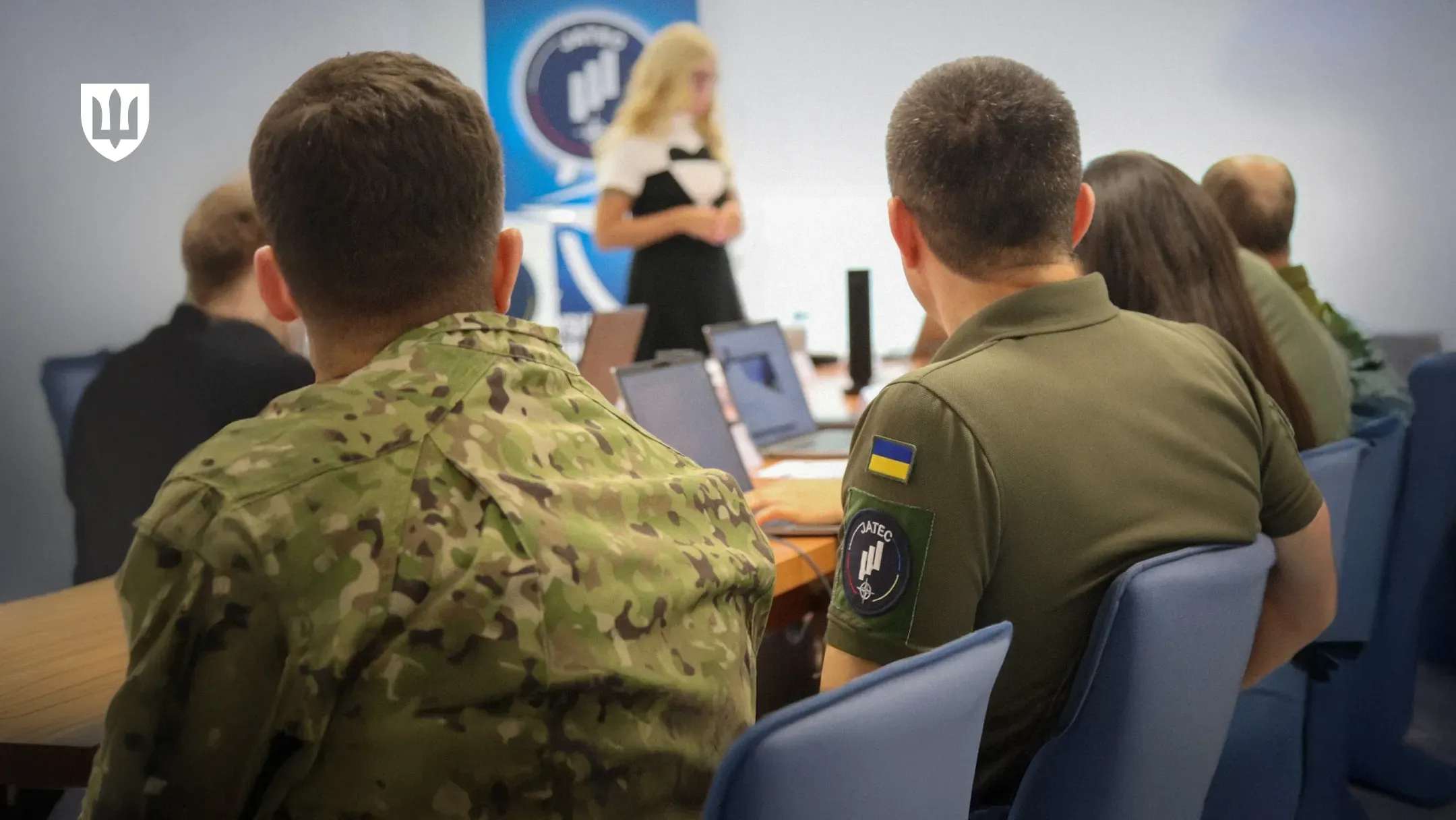
Today, dozens of service members from Ukraine and NATO member states attended a ceremonial event at JATEC headquarters in Bydgoszcz, Poland.
“Establishing a new organisation within NATO’s structure, jointly governed by NATO and Ukraine, is an ambitious undertaking. I am proud of our personnel, whose professionalism, creativity and dedication turn this vision into reality every day,” said Brigadier General Wojciech Ozga, Commander of JATEC.
The Centre has outlined five core areas of effort: the development of military affairs, digitalisation, education, comprehensive defence, and transformation and interoperability. In 2025, JATEC played a key role in organising three mission-focused NATO Innovation Challenges for Ukraine.
“JATEC has become a bridge for Ukraine’s practical integration into NATO through the exchange of experience across all areas of our project activities,” said Colonel Valerii Vyshnivskyi, Ukraine’s Senior National Representative to JATEC and Director for Programme Implementation.
He added that, for the first time, Ukrainian experts and analysts from NATO member states are working as equal partners to shape NATO doctrine, enhance capability development, and accelerate technological innovation.
About JATEC
The Centre became operational exactly one year ago and was established as NATO’s first partner organisation. JATEC analyses the russia–Ukraine war, drives interoperability between NATO and Ukraine, and supports transformational defence initiatives that accelerate NATO–Ukraine integration.
Within JATEC, Ukraine holds equal status with NATO member states. This format enables faster adaptation of approaches to cooperation with the Alliance.
Through JATEC, innovation for the modern battlefield is advancing, alongside the adaptation of defence planning processes. In this context, the Centre is creating a window of opportunity grounded in a shared understanding of collective defence mechanisms. It is serving as a strategic bridge between Ukraine and NATO.
Innovation and the development of combat capabilities
In 2025, three NATO Innovation Challenges were conducted, offering full-cycle support for innovative solutions for Ukraine.
Within the counter-aerial threat track, three solutions were selected:
- an AI-based solution for guiding UAVs against aerial targets by Alta Ares (with confirmed combat engagements against Shahed, Gerbera, and SuperCam UAVs);
- an interceptor drone from Tytan;
- the ‘drone wall’ concept proposed by Atreyd.
To counter fibre-optic-controlled FPV drones, three solutions have been selected:
- a cost-effective three-dimensional radar developed by KMB Telematics Inc. (Canada);
- an autonomous AI-enabled counter-drone turret by Sentradel (United States);
- an automated turret developed by DONS (Ukraine).
In the medical domain, three innovative solutions were selected:
- a continuous renal replacement therapy (CRRT) system, developed by Qidni Labs Inc.;
- a vacuum infuser for controlled medication delivery, developed by MonuMedical LLC;
- a battlefield vital signs monitoring system for service members, developed by Ixana.
In 2026, JATEC’s innovation efforts will focus on protecting battlefield vehicles against all types of UAVs and guided aerial bombs (GABs).
Ukraine’s participation in NATO collective defence exercises
JATEC integrates Ukrainian expertise into the planning, conduct, and evaluation of NATO collective defence exercises. For the first time, the North Atlantic Council approved the participation of Ukrainian representatives in the corps-level LOYAL DOLOS 25 exercises related to NATO Article 5.
For the first time, a Ukrainian representative participated in a meeting of NATO’s Military Training and Exercise Programme Planning Board. In addition, for the first time in NATO history, the Naval Forces of the Armed Forces of Ukraine led the planning and coordination of OPFOR forces during the REPMUS/Dynamic Messenger 25 exercises. Ukraine’s DELTA military situational awareness system functioned as the primary command-and-control instrument.
Engagement of Ukrainian companies
For the first time, JATEC engaged Ukrainian companies in joint research, analytical work, and innovation activities with NATO. Last year, this approach enabled two Ukrainian companies to secure relevant research contracts.
At the same time, contracting is underway for the winners of the NATO Innovation Challenges addressing guided aerial bombs (GABs) and fibre-optic-controlled FPV drones, supported through the Comprehensive Assistance Package Trust Fund for Ukraine (CAP TF). From 2026 onwards, several projects envisaged under JATEC’s programme will be funded through this package.
Analytics and digitalisation
Last year, digitalisation efforts focused on achieving an advantage in the use of artificial intelligence (AI) and machine learning (ML). In particular, the Defence Forces of Ukraine received AI/ML models for testing on real-world data, including assessments of fire-control loop effectiveness, target-identification accuracy, and threat forecasting for critical infrastructure.
Interoperability
In its first year, JATEC developed and coordinated plans to implement four priority interoperability requirements:
- the study and incorporation of lessons learned;
- reserve force development;
- medical support and care;
- professional military education and training.
JATEC’s participation contributed to progress in coordination activities supporting the implementation of the Ukraine–NATO Interoperability Roadmap.