What is the kill chain, and how does AI help destroy enemy targets faster?
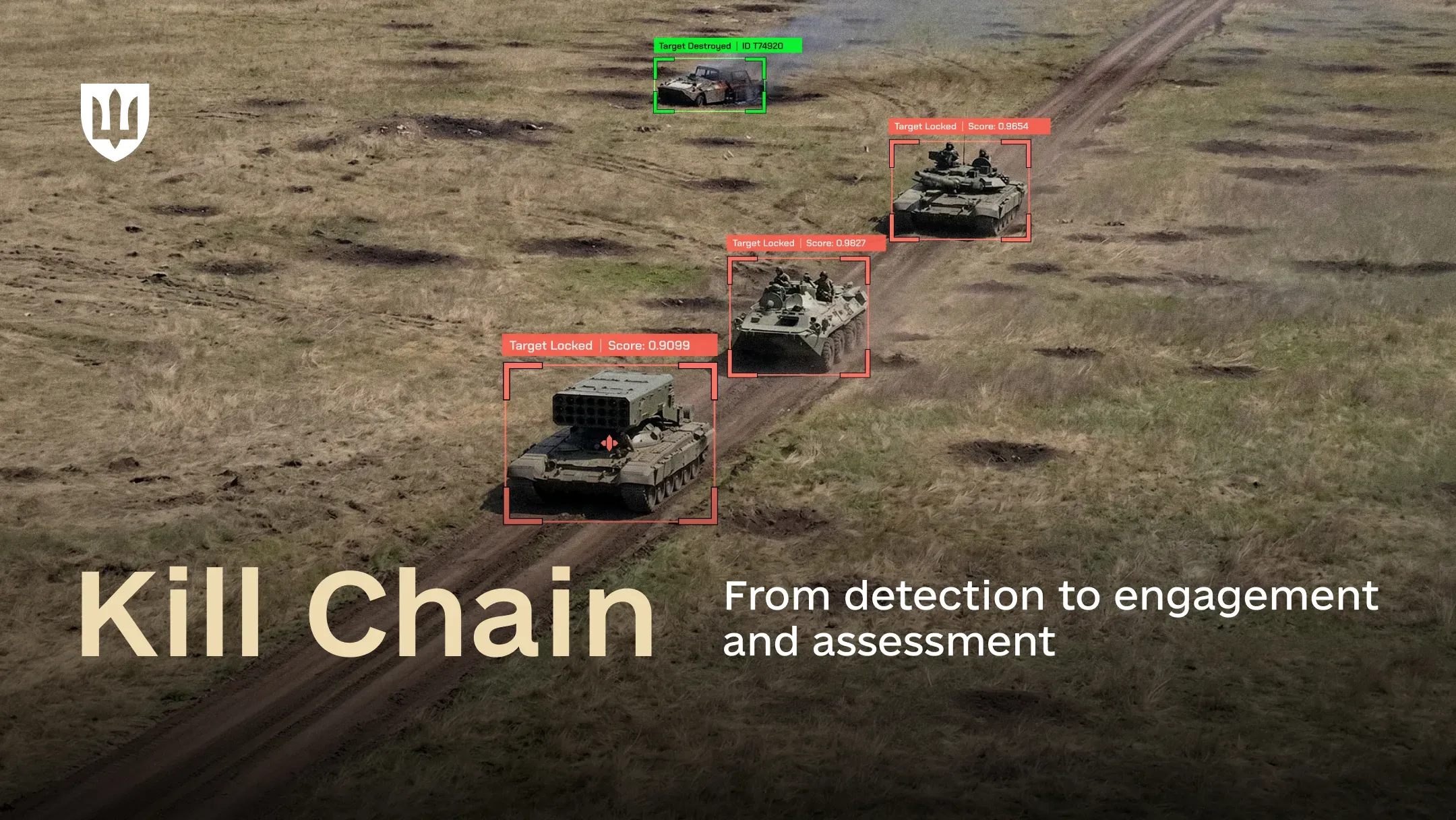
The Ministry of Defence of Ukraine outlines what a kill chain is and how AI helps make enemy target engagement even more effective.
Modern warfare demands extremely rapid decision-making while also requiring the processing of vast and ever-growing volumes of information. One of the key challenges remains ensuring that every stage of the kill chain – the sequence for engaging an enemy target, from detection to assessment of the outcome – is carried out as effectively as possible.
Understanding how this sequence works helps explain why Ukraine is investing so heavily in AI-powered data collection and processing systems, rather than focusing solely on weapons and other means of engagement.
Why the kill chain is one of the key concepts in modern warfare
The kill chain is a model that describes the structure of an attack as a sequence of essential stages:
- find – identifying an enemy object using intelligence, surveillance, and reconnaissance (ISR) capabilities;
- fix – determining the object’s precise coordinates and confirming its status;
- track – continuously monitoring the target’s movement in real time;
- target – selecting the most appropriate kinetic or non-kinetic means of engagement to accomplish the mission;
- engage – employing a weapon against the target at the designated coordinates;
- assess – analyzing the effects of the strike to determine whether re-engagement is necessary.
A key parameter of the kill chain is the time required to complete it. The less time that elapses between detection and the actual strike, the greater the likelihood of successfully destroying the target, as the enemy loses the window of opportunity to change position or employ concealment measures. This is a critical element in effectively countering the enemy.
At the same time, as with any chain, breaking a single link brings the entire process to a halt. This gives rise to the corresponding concept of “breaking the enemy’s kill chain” – disrupting one of the links in its attack process – as a form of defense or preemptive action.
How AI helps the Defence Forces of Ukraine make the kill chain more effective
In the past, coordinating a fire mission – from an observer detecting a target to the actual opening of fire – could take 15–20 minutes, or even longer, when done manually. In modern warfare, such a delay is effectively unacceptable.
This is where artificial intelligence comes in to assist human operators.
At the find stage of the kill chain, reconnaissance drones can use visual data repositories to detect objects. For this purpose, the Brave1 defense innovation cluster created Brave1 Dataroom, a secure platform that provides developers with access to structured datasets for testing, training, and fine-tuning military AI solutions.
Over 100 Ukrainian companies can already use this platform to train AI models on real-world data. The platform specializes in detecting and intercepting aerial targets, including Shahed-type drones.
To train drone AI systems using real-world battlefield data, the Ministry of Defence of Ukraine has provided Ukrainian developers with access to Avengers Labs. The platform provides access to an annotated dataset of 5 million frames collected during military missions.
The dataset is regularly updated, with the DELTA system serving as its primary source. Targets included in the dataset range from tanks, artillery, and air defense systems to enemy infantry groups and aerial targets, including reconnaissance UAVs and Shahed-type drones.
The Avengers AI platform, trained on the Avengers Labs dataset, has already been integrated into the Vezha module of the DELTA combat system. It identifies 70% of enemy military equipment in real time by analyzing more than 100,000 video streams each month.
The Ministry of Defence also launched the Defense AI Center “A1” in March – the first center of excellence focused on integrating artificial intelligence into defense processes and advancing technological solutions for modern warfare. Its mission is to continuously analyze the battlefield and technologies and identify the next steps in developing Ukraine’s defense capabilities.
AI's main contribution to the kill chain is not to replace any stage, but to reduce the time required for each one. Automated target recognition accelerates the find and fix stages, continuous video stream analysis facilitates tracking, and prioritization algorithms support the target stage by helping select the most appropriate means of engagement.
Together, these capabilities shorten the time from target detection to engagement, which in Ukraine’s battlefield context serves as the primary measure of overall battlefield effectiveness.
At this stage alone – detecting signs of enemy presence in images and video – AI can save analysts up to 90% of their time by automatically analyzing the imagery and identifying enemy positions and military equipment.
The human-in-the-loop principle
It is important to remember that Ukraine’s approach to the use of AI on the battlefield consistently adheres to the human-in-the-loop principle.
Simply put, the technology helps detect a target and accelerates its assessment, but the final decision to engage remains with a human, while the system’s level of autonomy is limited based on the potential cost of an error.
This is not merely a stated principle: requirements for the ethical use of AI, for example, are built into Brave1 grant programs, meaning that developers can receive funding only if they comply with these rules. In this way, Ukraine is setting global trends in the ethical use of artificial intelligence for military purposes.