Disrupting russian oil exports along the Baltic Sea coast: impact and consequences of strikes in the Leningrad Oblast
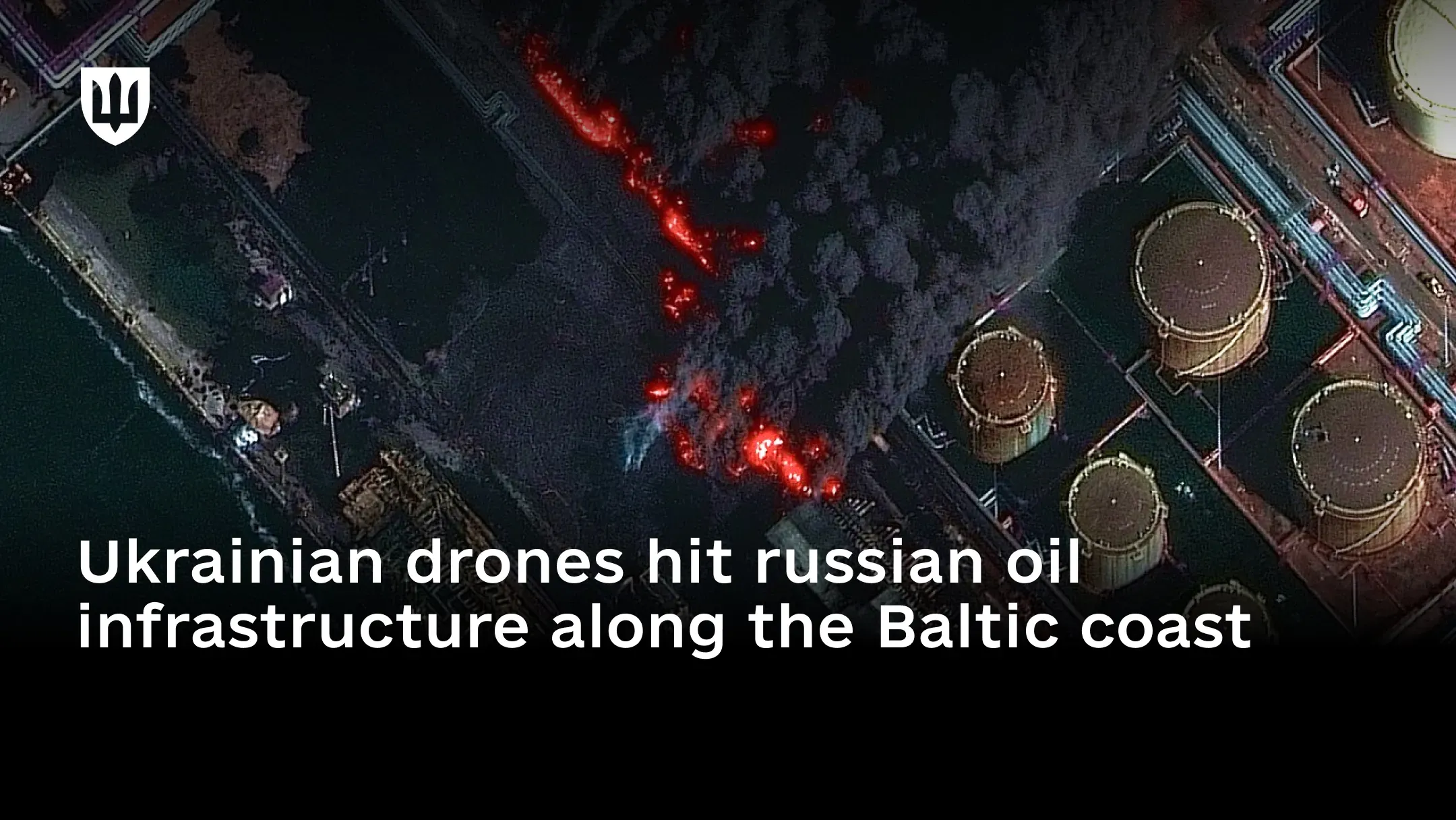
Over the past week, Ukraine’s Defence Forces conducted a series of coordinated precision strikes on infrastructure in russia’s Leningrad Oblast that support the aggressor’s war machine. Strikes on russian ports along the Baltic coast have blocked a significant share of russian oil exports.
The Ministry of Defence of Ukraine outlines which specific targets were struck and what this means for reducing the enemy’s offensive capabilities within the framework of Ukraine’s War Plan.
KINEF, one of russia’s largest oil refineries
On 26 March, drones hit crude distillation units and two large storage tanks at the KINEF refinery (Kirishinefteorgsintez) in Kirishi. A large-scale fire broke out at the facility and burned for several hours before being brought under control.
Why this matters. The Kirishi refinery is one of the three largest oil refineries in russia, with a capacity of around 21 million tonnes per year—over 6% of the country’s total refining output.
Consequences. Strikes on crude distillation units hit the “heart” of the refinery. Without them, the entire downstream processing chain comes to a halt. This results not only in disrupted oil exports but also directly impacts fuel supply (diesel, aviation fuel) for russian forces.
NOVATEK Ust-Luga complex
On 24 March, Ukraine’s Defence Forces struck the storage tank farm and marine loading arms at the NOVATEK Ust-Luga complex. Ukrainian drones covered a distance of 900 kilometers to reach the target.
Another strike on the facility was carried out overnight into 29 March. The attack resulted in substantial damage and a fire.
Why this matters. Ust-Luga serves as the primary “gateway” for russian exports in the Baltic Sea. As russia’s largest port on the Baltic Sea, it is one of the key hubs through which russia exports crude oil and petroleum products, including via vessels of the so-called shadow fleet.
Last year, russia exported over 30 million metric tonnes of petroleum products through the port of Ust-Luga.
The NOVATEK Ust-Luga complex processes stable gas condensate into higher-value petroleum products, including oil, kerosene, and diesel, for export markets.
Consequences. Damage to marine loading arms critically slows or completely halts fuel loading for export. This leads to direct losses in foreign currency revenues that fund the war effort.
Transneft Primorsk oil terminal
On 22 and 23 March, Ukraine’s Defence Forces struck crude oil loading infrastructure and storage tank facilities at the Transneft Primorsk oil terminal. Significant smoke and a fire were recorded.
Why this matters. It is the largest crude oil export port along the Baltic coast, handling up to 60 million tonnes of crude annually.
Consequences. Systematic strikes on such terminals force tankers to wait at anchor, drive up vessel insurance costs, and compel russia to seek more complex and costly ways to work around damaged infrastructure.
Vyborg Shipyard
On 25 March, the patrol icebreaker Purga (Project 23550) was struck at the Vyborg Shipyard.
Why this matters. This is not merely an icebreaker, but a hybrid military vessel. It is armed with artillery and can carry containerized Kalibr or Uran missile systems. It was intended for the Coast Guard of the FSB Border Service.
Consequences. Building and repairing vessels of this class takes years. Taking Purga out of action directly in the dock represents a significant setback to russia’s ambitions to control the Arctic and Baltic regions.
Systematic degradation of the aggressor
One of the objectives of Ukraine’s War Plan is to deprive russia of the economic resources required to wage war. In this context, coordinated strikes by Ukraine’s Defence Forces against oil infrastructure in russia’s Leningrad Oblast produce three key vectors of impact:
- Economic — blocking oil and petroleum product exports via the Baltic Sea deprives the russian budget of billions of dollars that are directly converted into missiles and ammunition;
- Logistical — fuel shortages are induced for russia’s troop groupings;
- Technological — successful long-range strikes exceeding 900 km highlight the inability of russia’s air defense systems to protect critical infrastructure even deep in the rear;
Thus, the Baltic Sea region has shifted from a “safe hub” to a high-risk zone for russia. The systematic destruction of oil infrastructure through deep-strike capabilities depletes the enemy’s resources and imposes long-term obstacles to the restoration of its military potential.
As previously reported, the Defence Forces of Ukraine struck 13 oil and gas infrastructure facilities in russia in January–February.