Results of July's middle strike operations: Logistics routes, air defenses, and drone bases hit
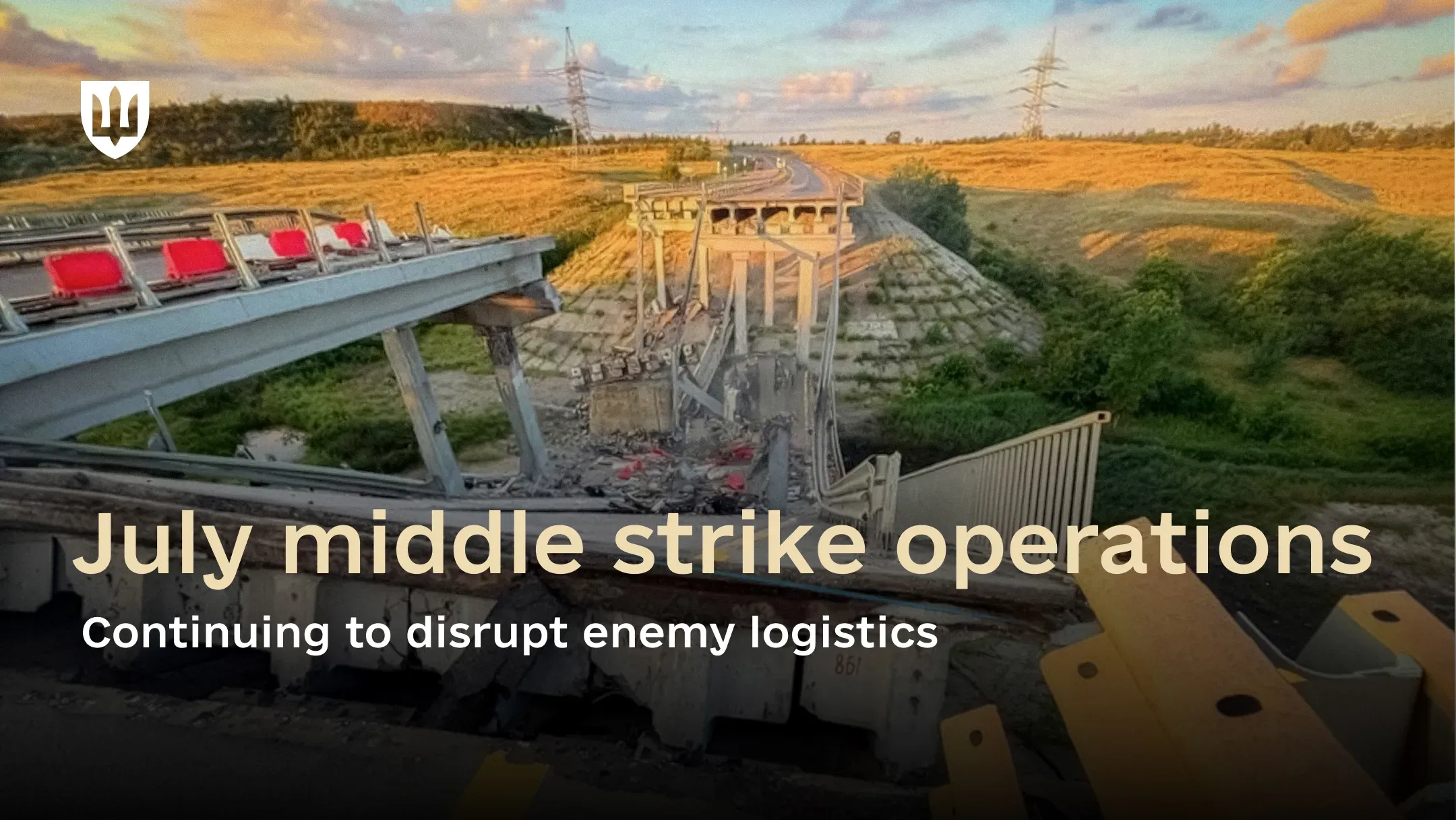
In July 2026, the Defence Forces of Ukraine continued their systematic middle strike campaign against the enemy's operational rear areas and logistics routes.
The campaign focused on disrupting supply routes in the Donetsk, Luhansk, Kherson, and Zaporizhzhia regions, as well as in the temporarily occupied territory of Crimea.
Disrupting russian logistics: Bridges and crossings struck
Enemy transportation infrastructure remained one of the priority targets in July. During the month, strikes were carried out against 14 railway and road bridges and overpasses, as well as pontoon crossings used by the enemy for military purposes.
Among the targets struck were:
- Donetsk region: road bridges over the Malyi Kalchyk River and the Kalka River (near Hranitne), the Hruzkyi Yalanchyk River (near Huselnykove), the Kalmius River (near Staromarivka), bridges near Novoekonomichne and Vyselky, as well as logistics crossings;
- Luhansk region: railway bridges over the Tepla River (Nyzhnioteple) and the Siverskyi Donets River (Stanytsia Luhanska), and a railway overpass near Dovzhansk;
- Crimea: railway bridges over the Krasnohvardiiske Canal, near Rozdolne and Ichki, and the Syvash railway bridge near Chonhar;
- Kherson region: road bridge across the Henichesk Strait;
- Zaporizhzhia region: road bridge near Prymorsk;
- Kursk region (russia): road bridge near Kozino.
Strikes on these transportation arteries complicate the movement of personnel, weapons, and ammunition, isolating sections of the front.
Blinding russia's air defenses and electronic warfare systems
Throughout July, the Defence Forces systematically destroyed enemy air defense systems and radar stations through middle strike operations.
At least nine targets were struck:
- an S-400 surface-to-air missile system and a Nebo-U radar (near Kerch);
- a Buk surface-to-air missile system (near Zelenopillia, Zaporizhzhia region);
- a Pantsir-S2 surface-to-air missile system (near Simferopol);
- Bussol-S radars (near Khorly, Kherson region) and an early warning radar (near Olenivka, Autonomous Republic of Crimea);
- a Murmansk-BN coastal electronic warfare system (Cape Fiolent), electronic warfare stations near Artemivka (Autonomous Republic of Crimea), and a Pole-21 electronic warfare system (Holubivka, Luhansk region);
- an electronic warfare equipment depot (near Novodarivka, Luhansk region).
Disabling these systems expands the opportunities for follow-on strikes by Ukrainian aviation and missile forces.
Striking russian UAV bases, aviation assets, and headquarters
Destroying infrastructure supporting strike and reconnaissance drones was an important focus in July. Strikes were recorded against more than 10 UAV command posts in the Zaporizhzhia, Donetsk, Sumy, and Bryansk (russia) regions, along with drone training and launch bases and pilot deployment locations.
Ground relay stations for Geran/Gerbera UAVs were destroyed near Chornomorske (Autonomous Republic of Crimea) and Zaliznyi Port (Kherson region), along with relay stations for Orion UAVs at Dzhankoi Air Base.
In addition, infrastructure at Saky Air Base in Crimea, including aircraft hangars, was struck, destroying or damaging at least seven aircraft of the Su-30, Su-30SM, and Su-24 types. Two hangars housing Shahed UAVs and aviation equipment were struck at Hvardiiske Air Base.
A base for high-speed boats near Mizhvodne was struck. A Project 10410 Svetlyak-class patrol boat was struck in Kerch.
A strike also hit a UAV depot near Chervonopopivka in the Luhansk region.
A strike also targeted an FSB coordination center in the Kherson region, where around 100 military personnel and more than 70 pieces of equipment were believed to be located.
In addition, a production workshop at an aircraft manufacturing plant in Yevpatoriia was struck.
Destroying enemy fuel infrastructure and supply depots
During the month, middle strike operations struck the TES-Terminal-1 oil terminal in Kerch, an oil depot in Shakhtarsk, Chornomornaftogaz facilities in Crimea, a fuel train near Tokmak, and a russian tanker in the Black Sea.
In addition, dozens of ammunition and logistics depots were struck.
To illustrate the scale of the impact: a single destroyed Murmansk-BN coastal electronic warfare system, tracked by Ukrainian intelligence near Cape Fiolent, was designed for signals intelligence and shortwave signal jamming over ranges of thousands of kilometers.
Its loss leaves significant gaps in the russian military's radar coverage. The simultaneous destruction of systems such as the Murmansk-BN, fuel terminals like TES-Terminal-1—one of the largest in Crimea—and key railway bridges creates a significant cumulative negative effect on the aggressor's ability to sustain the war.
Depriving the enemy of fuel, destroying key transportation arteries, and blinding air defense systems limit the russian military's ability to conduct offensive operations while creating conditions for effective operations by the Defence Forces of Ukraine in key operational areas.